
CANCEL CULTURE IN SOCIETY
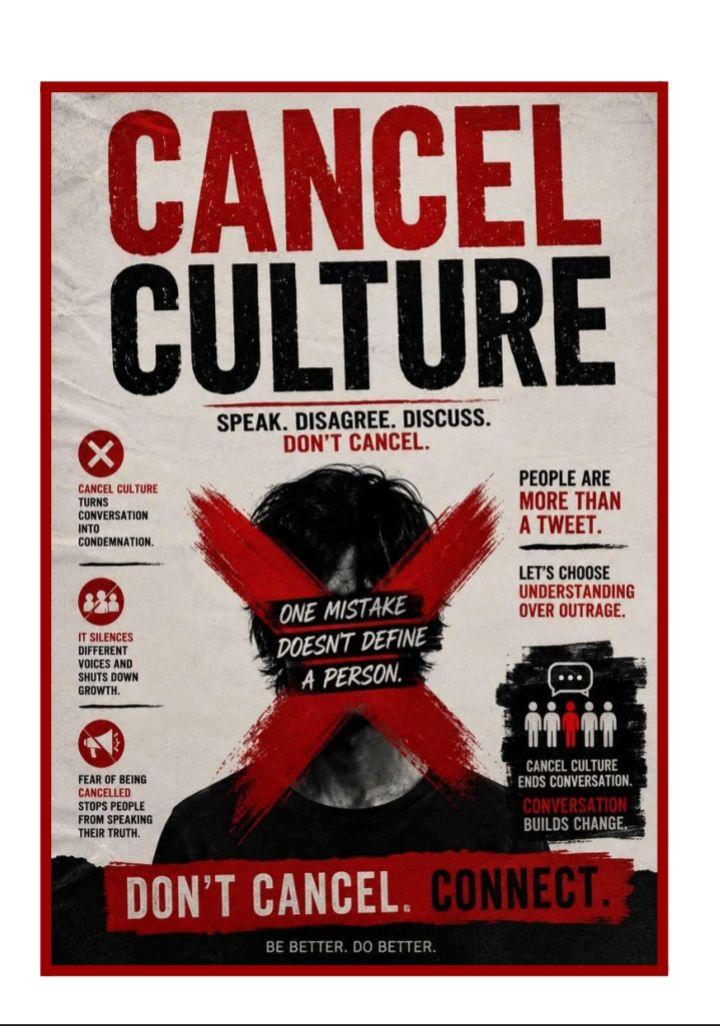
Cancel culture has become one of the most influential social phenomena of the digital age, shaping how individuals, organisations, and public figures are judged by society. For a clear understanding of this article, it is essential to understand what cancel culture entails. Cancel culture is the practice of publicly criticising, boycotting, or withdrawing support from a person, organisation, or public figure because of something they said or did that is considered offensive, harmful, or unethical. This often happens on social media, where large numbers of people can quickly call for accountability. For example, if a celebrity makes a discriminatory comment, people may stop buying their products, unfollow them on social media, or pressure companies to end partnerships with them. Whether this is viewed as justified accountability or as cancel culture depends on the circumstances and people’s perspectives.
As it’s popularly known, every concept or theory has its pros and cons. Therefore, cancel culture has both benefits and harms, which depend on how it is practised, the seriousness of the offence, and whether it promotes accountability or unjust punishment.
Of the many benefits of cancel culture, it can promote ethical standards by holding individuals, organisations, and public figures accountable for actions or statements that are considered harmful, discriminatory, or unethical. In the past, influential individuals could sometimes evade consequences due to their wealth, status, or power. However, cancel culture enables the public to demand accountability through collective action, encouraging those in positions of influence to act more responsibly. This increased scrutiny motivates individuals and institutions to uphold higher moral and professional standards.
Cancel culture also serves as a catalyst for social change by bringing attention to important social issues that might otherwise be ignored. Public campaigns against racism, sexual harassment, corruption, workplace harassment, and other forms of injustice have encouraged governments, businesses, and organisations to review their policies and implement reforms. In many cases, widespread public pressure has resulted in stronger workplace protections, greater corporate responsibility, and increased awareness of social inequalities. As a result, cancel culture has empowered marginalised groups to speak out against injustice and has contributed to broader conversations about equality, human rights, and social responsibility.
As earlier mentioned, cancel culture gives marginalised groups a voice. Social media has made it easier for people from historically marginalised communities to speak out against injustice and gain public attention. An example of this is evident in the case of the “ENDSARS” protest in 2020 in Nigeria, targeting an organisation that once had the support of the masses but faced serious condemnation after its corruption was confirmed.
In contrast, of the many harms cancel culture can cause in a society, it can encourage public harassment. Public criticism sometimes escalates into cyberbullying, threats, or coordinated harassment, causing significant psychological and emotional harm or even death. For example, in the case of a social media influencer who committed suicide after facing severe public criticism and slander for allegedly taking hard drugs. It was later revealed that her trusted friends, out of envy, had deceived her into thinking that drugs were for menstrual cramps, which she suffered from.
The early history of Islam also provides examples that can be used to reflect on the dangers of rejecting ideas or people simply because they challenge established beliefs. For instance, when Prophet Muhammad (صلى الله عليه وسلم) began preaching Tawhīd (the oneness of Allah) in Makkah, the Quraysh leaders strongly opposed his message because it threatened their religious traditions, social status, and economic interests tied to idol worship. Even though the Makkans earlier showed him love and support, he was boycotted and persecuted when he started to go against their religious beliefs.
Cancel culture may also ignore due process, which is the principle that a person should be treated fairly before being judged or punished. It involves hearing both sides of a case, examining evidence, allowing the accused to respond, and ensuring that decisions are based on facts rather than emotions or public pressure. However, cancel culture demonstrates how public opinion replaces established procedures, causing unfair judgements while depriving the victims of the right to defend themselves. This may result in the victims facing severe consequences even before evidence is revealed and known.
Cancel culture can also be disproportionate. A single mistake, especially one made years earlier, may lead to long-term damage to a person’s reputation, career, or state of mind, even after they apologise or demonstrate personal growth.
In addition, cancel culture may discourage open discussion. A healthy society depends on open dialogue, where people can express ideas, ask questions, disagree respectfully, and learn from one another. However, cancel culture can discourage this process in several ways. Fear of public backlash may discourage people from expressing opinions, asking questions, or engaging in constructive debate, limiting freedom of expression.
For example, lecturers avoid discussing a sensitive historical or religious issue in class because they fear that students might record a portion of the lecture and share it online without context. Some students may also avoid asking questions about cultural or religious differences because they fear that their questions might be interpreted as offensive. Cancel culture also encourages polarisation. Instead of encouraging respectful disagreement, it often divides people into opposing groups. Individuals become more concerned with defending their own side than understanding others.
Also, cancel culture may limit opportunities for rehabilitation. If society permanently rejects individuals without allowing them to learn from their mistakes, it reduces opportunities for personal growth and redemption.
In conclusion, cancel culture has generally done more harm than good because it often encourages public shaming, social exclusion, and harsh judgement without allowing people the opportunity to explain themselves, correct mistakes, or grow. While it can hold individuals and organisations accountable for harmful actions, it can also spread misinformation, fuel harassment, damage reputations permanently, and discourage open discussion out of fear of being attacked.
Rather than participating in cancel culture, the public should promote accountability with fairness and compassion. People should verify facts before reacting, listen to different perspectives, distinguish between honest mistakes and deliberate wrongdoing, and encourage sincere apologies, restitution, and personal growth where appropriate. Instead of seeking to silence or permanently ostracise others, society should foster respectful dialogue, forgiveness when genuine change is demonstrated, and justice that is proportionate to the offence.
This approach strengthens social cohesion while still addressing harmful behaviour responsibly.
From an Islamic perspective, people should be held accountable for wrongdoing, but accountability should be based on truth, fairness, and due process rather than on humiliation, rumour, or the refusal to allow repentance. Therefore, Islam encourages believers to:
I) Verify information before accepting or spreading it (Qur’an 49:6).
II) Avoid ridiculing and insulting others (Qur’an 49:11).
III) Avoid suspicion, spying, and backbiting (Qur’an 49:12).
IV) Speak with wisdom and kindness (Qur’an 16:125).
V) Forgive those who sincerely repent (Qur’an 24:22).
IN ESSENCE, BE CONSIDERATE OF OTHERS.
alfaaedahpress
Al-Faaedah is the flagship journal of MSSN Akinyele Area Council, promoting authentic Islamic scholarship, moral leadership, student mentorship, and societal development.
Did you find this reflection beneficial?
Your feedback guides our editorial board on future essays and dispatches.
Reader Discussion (3)
A deeply insightful exploration. The balance between academic discipline and spiritual consciousness is precisely what our student body needs today.
Barakallahu feek Brother Ahmad. May Allah grant our youth steadfastness in learning and practice.
Jazakumullahu Khayran to the editorial team. The references from Surah Taha were especially grounding.
Related Perspectives & Notes

ISLAMIC BANKS IN PRACTICE: A CRITICAL ASSESSMENT OF SHARI‘AH COMPLIANCE
By Abdullah Qosim “If an institution bears the name ‘Islamic’, should its legitimacy be measured solely by the contracts it executes, or also by the ethical ide...

The Weight of Being Seen: Living Authentically in an Age of Performance
By Qamardeen Adeyemi A. Understanding the Concept The increasing difficulty of living without imagining an audience is something unusual about being human in th...