
How Ahmed Saheed Olaide Did It: The Road to Achievement and How Challenges Were Overcome


Everyone sees the success, but few know the story behind it. In this exclusive interview with Ahmed Saheed Olaide, who shares the real journey behind the achievements, the challenges faced, the lessons learned, and the mindset that made the difference.
As-salāmu ʿalaykum warahmatullāh wabarakātuh, Sir. To begin, could you kindly introduce yourself to our readers?
Wa ʿalaykumu s-salām warahmatullāh wabarakātuh.
My name is Ahmed Saheed Olaide. I am a Doctor of Veterinary Medicine, a public health and One Health advocate. I currently lead the BioShield Squad, which won the prestigious 2025 Trinity Challenge Seed Funding for our “Level Up Biosecurity; Lock Out AMR” project, currently ongoing across Sub-Saharan Africa. I’m also the 2025 World Veterinary Association (WVA) Global Veterinary Awards Veterinary Student of the Year, the first from Nigeria and Africa to ever receive this honour. My work sits at the intersection of animal health, human health, and environmental safety, with a vision to drive global policy change through grassroots impact.
You recently emerged as one of the grand winners of the MSSN Academic Excellence Award. How did that moment feel for you?
It was an incredibly humbling and affirming experience. Coming from a background where balancing academic rigour, faith, and leadership responsibilities hasn’t always been easy, this recognition meant more than just recognition . It was a moment of reflection, a reminder that with the right intention (niyyah), even the most silent efforts can attract divine favour and visible results.
At Al-Faaedah Press Organisation, we place great emphasis on consistency and dedication. How have these values played a role in your academic journey?
Consistency and dedication have been my backbone. I often tell people: brilliance without discipline rarely leads to lasting excellence. There were times I didn’t feel motivated, but because I had a clear purpose and structure, I showed up regardless. Whether it was attending early morning labs, preparing for national events , or submitting proposals, consistency kept me grounded and gradually built momentum toward success.
Reaching this level of success is no small feat. Could you share some of the major challenges you faced along the way?
There were many. Financial instability was one, I had to apply for multiple bursaries and work on the side to support myself. At one point, I was leading national and international projects while preparing for my final professional examinations. It was exhausting. Then there’s the constant challenge of limited access to global opportunities from Nigeria, such as visa denials and funding constraints. But each challenge taught me resilience, creativity, and how to navigate systemic barriers without compromising my values.
Was there a defining moment when you realised that you had the potential to achieve global honours like this?
Yes. I think it was when I began to see the real-world impact of our AMR and One Health outreach in communities, abattoirs, and schools. When organizations began reaching out and the work started getting international attention, I realised, “Okay, maybe this isn’t just a local effort, maybe this can shape global health conversations.
Did you ever struggle with self-doubt? If so, how did you navigate through those challenging periods?
Many times. There were periods I questioned whether I was doing enough or whether I deserved some of the platforms I was given. What helped was reminding myself of why I started, reconnecting with mentors, and realising that feeling doubt doesn’t mean you’re incapable, it means you care. My faith also reminded me that everything is by Allah’s permission, and He doesn’t burden a soul with more than it can bear
Balancing academics and extracurricular activities is often a struggle for students. How did you manage both successfully?
It wasn’t easy. I had to become extremely intentional with my time. I mapped out my priorities weekly, delegated when needed, and blocked off specific hours for rest and worship. More importantly, I built a system that allowed me to flow between student, leader, and servant roles without losing sight of my identity.
Are there any specific study techniques or routines that proved most effective for you?
Yes. I relied heavily on active recall, spaced repetition, and past question analysis. I also integrated group discussions and teaching others, it helped reinforce my understanding. Beyond technique, I created an environment that minimise distractions and protected my focus. Studying was strategic, not just hard.
How has your faith (Islam) contributed to your academic and personal growth?
My faith has been central to everything. It gave me clarity, grounded me in purpose, and reminded me that knowledge is a trust. When things got overwhelming, salah, du‘ā’, and tawakkul kept me going. I didn’t see faith and excellence as separate; I saw them as fuel for each other.
Now that you’ve earned international recognition, what’s next for you?
In shā’ Allāh, I plan to pursue a PhD focused on One Health, AMR, or veterinary public health, and to work with global agencies. I also want to mentor other African students and build systems that amplify youth-led innovation in global health.
Lastly, what words of advice or encouragement would you offer to students aspiring to excel academically and make a global impact like you?
Start where you are, with what you have but be clear on your why. Excellence is built on small, consistent efforts, not overnight miracles. Stay sincere, serve others, and seek help when you need it. And most importantly, let your faith drive your ambition, not limit it.
alfaaedahpress
Al-Faaedah is the flagship journal of MSSN Akinyele Area Council, promoting authentic Islamic scholarship, moral leadership, student mentorship, and societal development.
Did you find this reflection beneficial?
Your feedback guides our editorial board on future essays and dispatches.
Reader Discussion (3)
A deeply insightful exploration. The balance between academic discipline and spiritual consciousness is precisely what our student body needs today.
Barakallahu feek Brother Ahmad. May Allah grant our youth steadfastness in learning and practice.
Jazakumullahu Khayran to the editorial team. The references from Surah Taha were especially grounding.
Related Perspectives & Notes
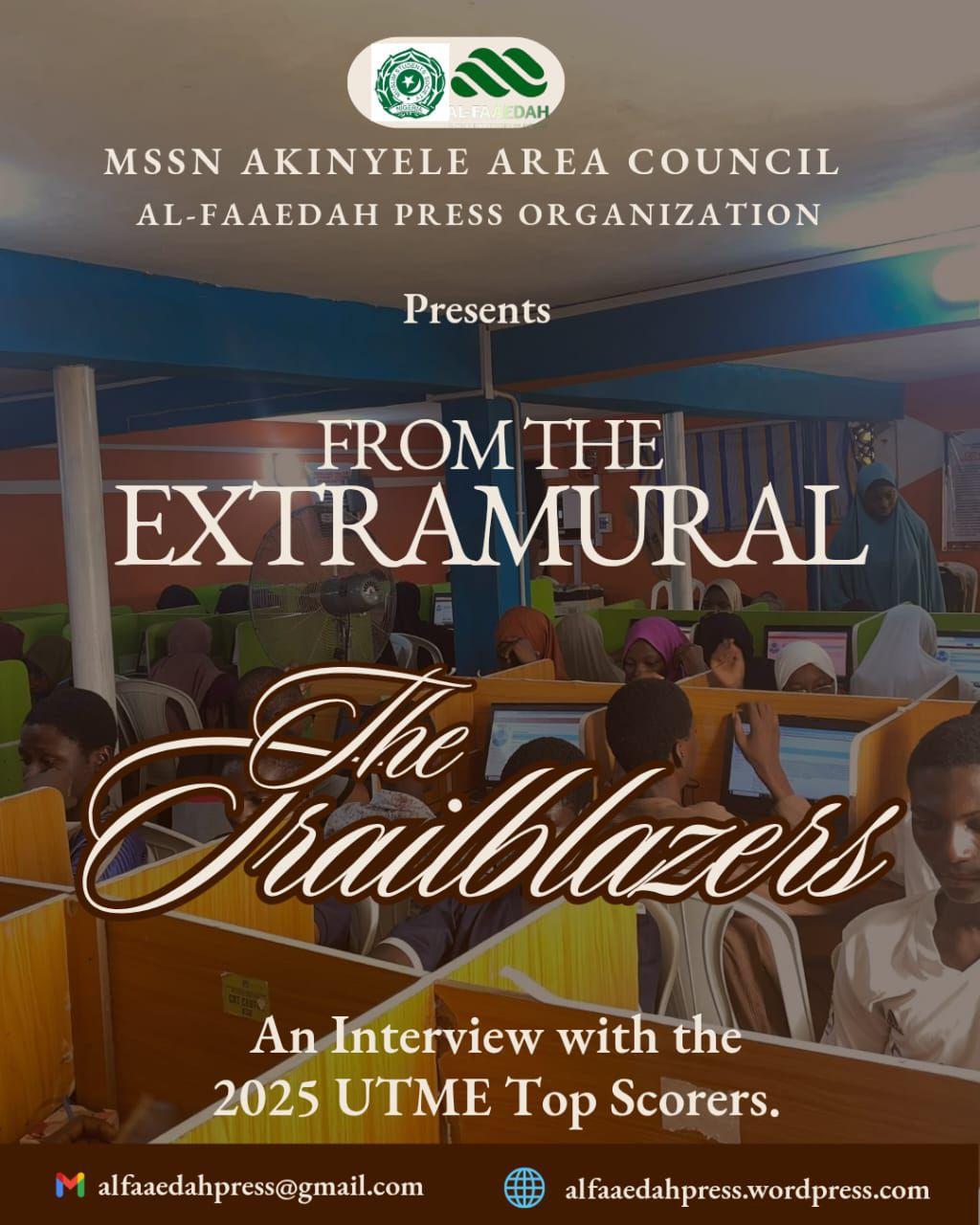
INTERVIEW: “Extramural nurtures not only our academic excellence but also our spiritual consciousness. It is a place where mentorship, discipline, and moral guidance go hand in hand with academic training. In my opinion, this balance makes Extramural truly exceptional among tutorial centres.” — Mubarakah Adebimpe Adetunji
In this interview, Mubarakah Adebimpe Adetunji, one of the trailblazers of the MSSN Akinyele Area Council's Extramural Tutorial Centre, shared with us her strat...

INTERVIEW: “Extramural is a place to be. You will learn a lot of lessons” — Rodiyah Adewumi Taiwo
In this interview, Rodiyah Adewumi Taiwo, one of the trailblazers of the MSSN Akinyele Area Council's Extramural Tutorial Center, shared with us her strategies,...

INTERVIEW: “The bulky syllabus was a major challenge. I overcame it by attending every class and avoiding distractions.” — Adeoti Abdul-shakur Opeyemi
In this interview, Adeoti Abdul-shakur Opeyemi, one of the trailblazers of the MSSN Akinyele Area Council's Extramural Tutorial Centre, shared with us his strat...