
The Benin Bronzes: A Civilisation So Advanced It Embarrassed Those Who Claimed to Civilise It
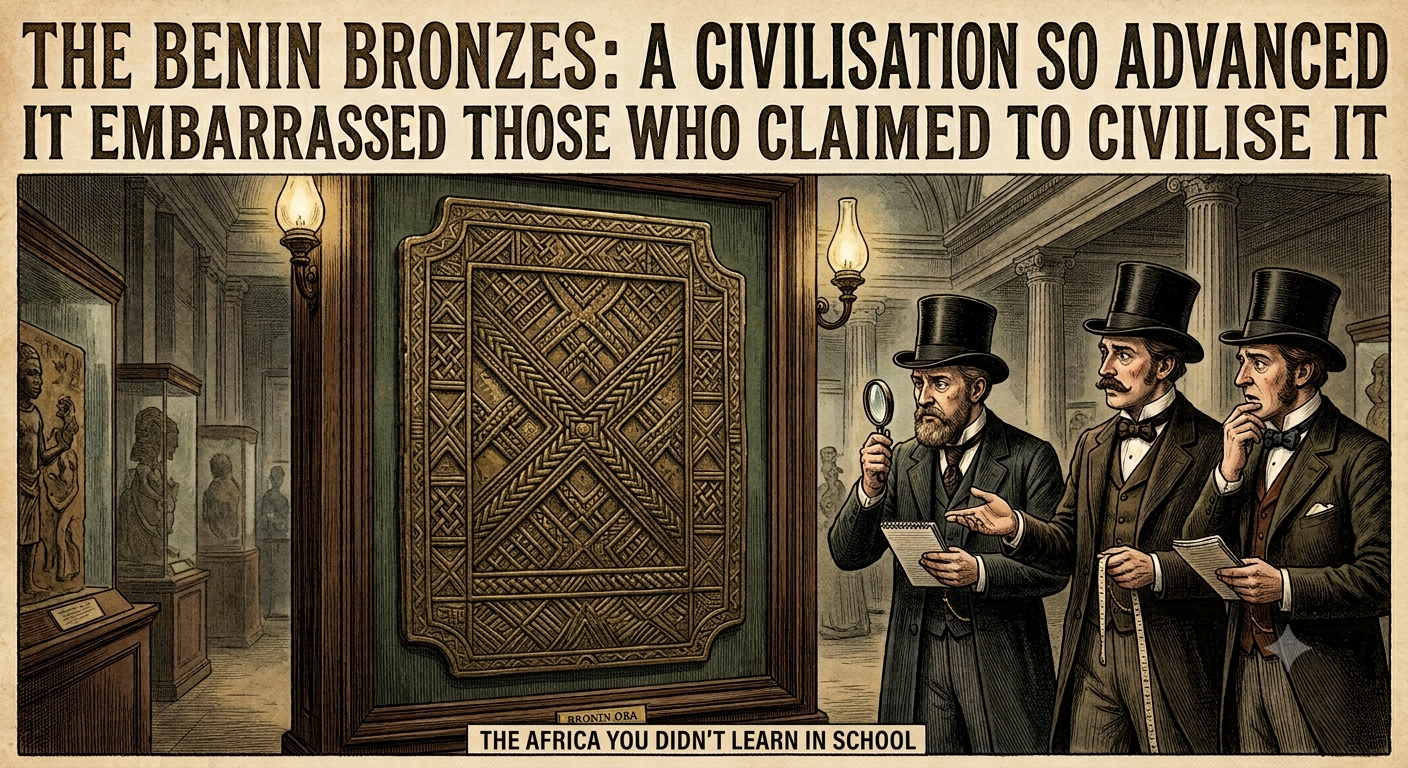
By Monsuru Islamiyya Olaseni
Africa had no art, they said. Then they stole 10,000 pieces of it.
In 1897, British soldiers marched into Benin City expecting to find savages. Instead, they found thousands of cast metal masterpieces so precise, so technically flawless, that European experts would spend decades refusing to believe African hands had made them. The evidence didn’t fit the story they came to tell, so they rewrote it the only way conquerors know how: they stole it, shipped it home, and auctioned it off. This is the story of the Benin Bronzes, proof of genius so undeniable that colonial Europe’s only answer was to loot it and lock it away.
A Kingdom Built on Memory
The Kingdom of Benin had been thriving for centuries before any European set foot on its soil. By the time of the 1897 invasion, its royal court had been commissioning cast metalwork since at least the 1500s, produced by a specialist guild working exclusively for the Oba, or king. Some pieces date back even further, with large-scale casting expanding under Oba Ewuare I in the mid-1400s.
The Edo people had a word for this craft, sa-e-y-ama, which literally translates to “to cast a motif in bronze,” but its deeper meaning is simply “to remember.” That distinction matters. These were not decorative trinkets. They were a nation’s memory, rendered permanent in metal.
Despite the popular name, most of the pieces weren’t bronze at all. They were brass, alongside works in wood, ivory, coral, and leather. But the materials mattered less than the message: the palace plaques recorded Benin’s dynastic history, its social order, its wars, and its diplomatic dealings with neighbouring kingdoms, offering a visual archive of a civilisation that kept meticulous account of itself long before colonial contact.
Rivalling the Renaissance
The technique behind these works, lost-wax casting, required a mastery of metallurgy that few societies anywhere had achieved at the time. When European collectors and curators first encountered the bronzes, many refused to believe African artisans had made them, insisting they must have been imported or influenced by outsiders.
One of the more telling reactions came from a curator at the Berlin Ethnographic Museum, who compared the craftsmanship to that of Benvenuto Cellini, the legendary Italian Renaissance sculptor, and rated the Benin work as good as, if not better than, anything Cellini himself produced. It was a backhanded compliment wrapped in disbelief, but the message was unmistakable: this was mastery that rivalled Europe’s own most celebrated artists, produced by a kingdom the invaders had come to “civilise.”
Benin’s contact with Europe wasn’t new by 1897 either. Trade and diplomatic relations with Portugal stretched back to the late 1400s, and some of the plaques themselves depict these early encounters, Benin recording Europe’s arrival on its own terms, in its own art.

The Theft
During the 1897 invasion, officially a “punitive expedition” launched after a British delegation was killed attempting to force its way into the kingdom during a sacred ceremony, British forces looted an estimated 10,000 objects from the palace: plaques, ivory, wood carvings, coral regalia, and more. Oba Ovonramwen, the reigning king, was captured and exiled. By 1898, most of the seized treasures had already been auctioned off across Britain, Germany, and Austria, scattering centuries of Benin’s recorded history into private collections and museum vaults thousands of miles from home.
For over a century, most of the world encountered the Benin Bronzes only as museum curiosities, stripped of the context that made them extraordinary in the first place: evidence not of a people who needed civilising, but of one whose civilisation had simply been misunderstood, then robbed.
Coming Home
That’s beginning to change. Since 2007, the Benin Dialogue Group, bringing together Nigeria’s National Commission for Museums and Monuments, representatives of the Oba, and curators from major European museums, has been negotiating the bronzes’ return. Some institutions have already acted: the University of Aberdeen and London’s Horniman Museum have both agreed to repatriate pieces from their collections.
As one descendant of the Benin royal family put it, the artwork represents centuries of his people’s history, taken from them like pages ripped from a book. Slowly, some of those pages are being returned.
The rest remain scattered across foreign vaults, but the point they were always meant to prove no longer needs repeating. Africa’s advancement was never the question. The willingness of the world to see it, that was.
Sources: National Commission for Museums and Monuments, J.U. Egharevba, “A Short History of Benin”, British Museum, Smarthistory, Apollo Magazine, Britannica
alfaaedahpress
Al-Faaedah is the flagship journal of MSSN Akinyele Area Council, promoting authentic Islamic scholarship, moral leadership, student mentorship, and societal development.
Did you find this reflection beneficial?
Your feedback guides our editorial board on future essays and dispatches.
Reader Discussion (3)
A deeply insightful exploration. The balance between academic discipline and spiritual consciousness is precisely what our student body needs today.
Barakallahu feek Brother Ahmad. May Allah grant our youth steadfastness in learning and practice.
Jazakumullahu Khayran to the editorial team. The references from Surah Taha were especially grounding.
Related Perspectives & Notes

Great Zimbabwe: The Stone City That Forced the World to Rethink African Civilisation
By Zainab Ikeoluwa Mustapha In the rolling hills of southeastern Zimbabwe, not far from the town of Masvingo, there's a wall. It doesn't look like much in a pho...
The Dahomey Amazons: Africa's Elite All-Female Army That Terrified European Forces
By Monsuru Islamiyat Olaseni. For nearly two centuries, the Kingdom of Dahomey did what no other kingdom on record had done: it built and sustained a standing a...