
THE LUMINARY LEDGER: AN INTERVIEW WITH RIDWAN AYOMIDE AGBOOLA
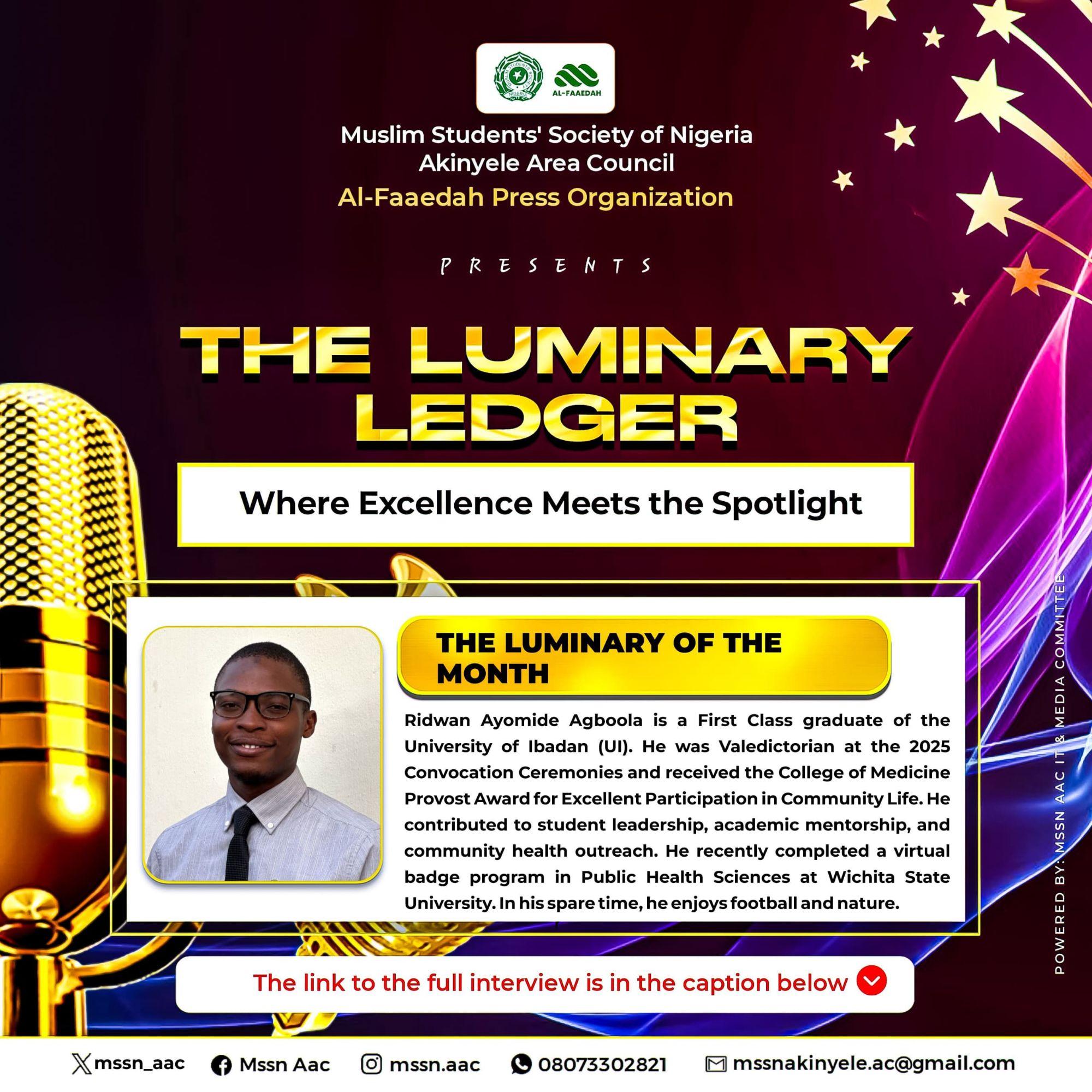
In this interview, Ridwan Ayomide Agboola, a Valedictorian at the 2025 University of Ibadan and oral presenter at the 9th Unibadan Conference of Biomedical Research, shared with the Al-Faaedah Press Organization his experiences, academic journey, and how he remained resilient throughout his undergraduate years despite coming from a low-income family. He is a leader, researcher, scholar, and winner of many academic and non-academic awards.
Al-Faaedah Press Organization would love you to introduce yourself to our readers.
I am Ridwan Ayomide Agboola, a recent graduate of Medical Laboratory Science from the University of Ibadan. I am the first child in my family, and I have two younger brothers.
You graduated from the Department of Biomedical Laboratory Science. What influenced your choice to study this specific course, and what kept you motivated through the years?
My decision to study Medical Laboratory Science (MLS) wasn’t tied to anything specific. I had always wanted a healthcare career, even though my parents were non-science professionals and I had no early exposure to medicine. Initially, I put in for MLS after falling short of the marks required for Medicine and Surgery. I could have pursued my first choice, but I resolved to give my best to whatever path I found myself on.
I believe this is where Allāh wants me to be at this stage of my life. Later on, as I began to understand the limitless scope of Medical Laboratory Science, I became positively hooked, and it was no surprise that I stayed dedicated to the program. I am grateful to Allāh for granting me a beautiful ending at the University of Ibadan.
Can you walk us through your academic journey from 100 level to graduation? Given how demanding the Faculty of Basic Medical Sciences is, how did you manage to stay focused and handle the intense academic pressure?
Each level in the University of Ibadan came with its own kind of “shege,” and navigating the academic environment was no small task. For me, the most stressful stage was 200L. In 200L, the BMLS curriculum required us to juggle courses from both the Faculty of Science and the Faculty of Basic Medical Sciences, and the timetable was far from favourable. To cope, I took breaks often and got involved in extracurricular activities, which helped me keep my mind off academic stress. Those moments of pause and engagement outside academics greatly boosted how quickly I was able to rejuvenate. It taught me that balance is not just about hard work but also about knowing when to step back and recharge.
Early on in school, you were already holding leadership positions, such as co-chairing the NIMELSSA_UI Academic Committee. How were you able to balance these roles with your heavy medical school coursework without letting your grades drop?
Before co-chairing the academic committee in 300L, I had already gained experience as a class representative in my first and second years. That role, though it might seem small, helped me develop skills, resilience, and management acumen that later made balancing responsibilities easier. Of course, I lost balance a few times. But Alhamdulillah, I was favoured by Allāh to bounce back unscathed. I believe planning and prioritisation played a huge role, and finding a pattern that worked for me made all the difference.
You served as class representative for five straight years (2020–2025) and chaired the department’s Electoral Commission. What personal values or skills helped you consistently earn the trust of both your classmates and the faculty?
I think my classmates and faculty see me as someone trustworthy and a proponent of the best interests of the class. To be frank, my patience and integrity were tested, and I faced a lot of disappointment. I was able to learn from my experience and pursue beneficial outcomes in every instance. I would say the personal values included honesty, service to others, and accountability.
In the 2023/24 session, you served as Chairperson of the House Committee on Budget Appropriation and Implementation for the Alexander Brown Hall Assembly. What did managing student allocation funds teach you about financial responsibility and transparency?
It’s not only about what you earn. What you spend on and invest in plays a big role in your financial life. If you are not transparent with financial matters, especially when handling other people’s funds, you may end up telling lies to cover yourself. But are you truly exonerated or going against Allāh’s rules on wealth and finance?
You were the Day 1 Valedictorian for the UI 2025 Convocation Ceremonies, speaking on behalf of 5,900 students. How did it feel to stand on that stage?
And what central message did you share in your speech?
To be frank, the feeling was surreal. Even though I was Valedictorian for my department, I never imagined I would be chosen to speak on behalf of 5,900 graduating students at the convocation ceremony of the University of Ibadan (Nigeria’s first and best University). It was such an honour to share my journey and reflect on how the university had shaped me into who I am today. In my speech, I took my fellow graduates on a brief memory lane and encouraged them to position themselves while pursuing opportunities that would make them a force to be reckoned with in whatever community they find themselves in. That moment reminded me that representation is powerful, and the joy of speaking for so many peers was truly unforgettable.
You graduated with the highest CGPA in your faculty and won multiple awards, including the Faculty Prize and the Best Graduating Student Award. What was your daily study routine or “secret” to maintaining such top-tier excellence?
After my very first test result in UI came out, all I could think of was that I might get “tsunamized” or “eroded” into another department. Alhamdulillah, that didn’t happen. I truly believe I am a product of blessings from Allāh, and prayers really do matter. My style has always been to study gradually before tests and exams creep in. Contrary to popular belief, I never did TDB. The one time I tried, I ended up sleeping TDB instead.
For me, prioritisation of courses was key. Each course has its own level of complexity, so the approach and time dedicated to each one mattered a lot. Group studies also played a big role, especially when revising for my professional examinations. And most importantly, I learned that finding a pattern that works for you makes everything better. Don’t copy others! Your own rhythm is what will carry you through.
Can you share your journey of seeking scholarships and bursaries, and how it has shaped your resilience?
Coming from a low-income home, academic and living expenses at the College of Medicine can be a bit difficult to handle. As an undergraduate, I applied for over 40 scholarships/bursaries.
Despite the effort I put into applying for scholarships, I got rejection letters mostly. Along the way, I got bursaries and scholarships from the University of Ibadan Muslim Community, Ibadan Descendant Union New York Chapter, Zeribe Nwosu Foundation, ASCP, and the Oyo State Government. My scholarship journey has taught me that rejections are somehow inevitable. The only thing is to learn from the rejections and let the knowledge enhance your future applications. Also, understanding the focus of a scholarship would determine your approach to it.
In 2025, you were an oral presenter at the 9th Unibadan Conference of Biomedical Research. Can you briefly tell us what your research was about and how it felt to contribute to the scientific community as a student?
My final year project allowed me to present research on public health on a larger stage. A colleague and I jointly submitted an abstract. Our abstract was accepted, and my presentation focused on the elevated levels of cadmium (a toxic element) found in local automobile repair artisans and the harmful effects on their livers and kidneys. Before the presentation, I met with the artisans to share the findings, and I was encouraged by how attentively they listened to the risks tied to their daily work. The chance to contribute to public health knowledge and raise awareness made the entire experience deeply rewarding.
You have stepped into prestigious international platforms, such as the 2025 Aspire Leaders Program by Harvard Business School’s Aspire Institute and become an ASCP Scholar. How did you prepare yourself for these global opportunities?
A wise man once said, “Access and information will take you far”. I believe that is true, and I would add that gradual positioning makes it easier to pursue global opportunities. Over time, I have been a consistent advocate of personal development, because sometimes all it takes is a little information to inspire the courage to leap. Whatever you have now, whether it’s in grades or knowledge, there are opportunities out there you can enjoy. Keep at it!
You participated in several extracurricular activities and served in various positions as a student at the University of Ibadan. Could you share with us some of these activities and what you enjoyed most?
At MSSN UI, I held the position of Publicity Secretary for the Circle of Prelim Muslim Science Students (CPMSS). Later, within MSSN UCH, I briefly served as Editor-in-Chief of the Al-Ilaaj Editorial Board and as Deputy Chairman of the business arm, Al-Falah. I served in the Ramadan Planning Committee (RPC), and I also contributed by donating blood through Al-Ansar.
Beyond MSSN, I actively encouraged mental health advocacy with the Asido Campus Network (ACN). I was Director of Media and Publicity at Smilebuilders Initiative (SBI), and in Alexander Brown Hall, I served two terms in the legislative arm, chairing the House Committee on Budget Appropriation and Implementation. Together with a colleague, I co-organised a Community Health Awareness Program (CHAP) in the Abadina community, offering basic health checks and sensitising residents on environmental hygiene.
My volunteerism further extended to the Junior Chambers Initiative Nigeria, UCH, where I participated as a medical volunteer and relief donor. I also oversaw a smooth and transparent electioneering process as Electoral Chairperson. I represented my class in football and played for Blazers FC, a team that clinched the Dr Aire Football Association Cup in 2024.
What I found most fulfilling was the spirit of service and volunteering.
Looking back at everything you achieved at UI, from the laboratory to student politics, what core skills would you say have been the most useful in getting you to where you are today?
Communication, Ability to work with others, Accountability and Time Management.
You received an Award of Academic Excellence from MSSN Unibadan and the “Icon of Integrity” title from the NIMELSSA National Chapter. How did your faith help keep you grounded, and what advice do you have for Muslim students trying to balance high grades with community service?
I am grateful to Almighty Allāh for the “Icon of Integrity” award. Though it required many votes, I am thankful that my values and conduct were enough to convince people I was worthy. Islam teaches us to seek beneficial knowledge while also giving attention to Akhlaq, and I strive to live by the Prophet’s (SAW) saying: “The best of you in Islam are those with the best character.”
I am not perfect, only a work in progress. My advice to Muslim students is to let Islam be their guiding light and to put sincere effort into everything they do.
You received both the “Provost Award for Excellent Participation in Community Life” and an “Award for Altruistic Service”. How does your Islamic faith shape your understanding of community service, and how do you intend to bring this focus on altruism into your career as a Medical Laboratory Scientist?
Alhamdulillah for Islam. Muslims have always been enjoined to engage in the community, especially towards beneficial causes. The desire to help out comes easily for me, and I believe Allah will continue to aid me in whatever sphere I find myself in
Is there anything about your story, a particular challenge you overcame, or a key person you’d like to thank that we haven’t talked about yet?
Everyone I interacted with at the University of Ibadan contributed in a way to who I am today. So, I would like to say a big JazakumuLlāhu khairan to them all. Notably, I must not fail to appreciate my parents and brothers for their support and sacrifices.
alfaaedahpress
Al-Faaedah is the flagship journal of MSSN Akinyele Area Council, promoting authentic Islamic scholarship, moral leadership, student mentorship, and societal development.
Did you find this reflection beneficial?
Your feedback guides our editorial board on future essays and dispatches.
Reader Discussion (3)
A deeply insightful exploration. The balance between academic discipline and spiritual consciousness is precisely what our student body needs today.
Barakallahu feek Brother Ahmad. May Allah grant our youth steadfastness in learning and practice.
Jazakumullahu Khayran to the editorial team. The references from Surah Taha were especially grounding.
Related Perspectives & Notes

INTERVIEW: “I was very confident in my academics until life humbled me.” — Ajibade Khadijat Adepeju.
In this interview, Ajibade Khadijat Adepeju, one of the trailblazers of the MSSN Akinyele Area Council's Extramural Tutorial Centre, shared with us her strategi...