
MU’AADH BN JABAL – The Imam of those who have knowledge on the day of resurrection
By Tolase Sodiq
He is Mu’aadh bn Jabal bn ‘Amr bn ‘Aws bn Ka’b bn ‘Amr AL-Khazrajee AL-Ansaaree. He is a noble companion [a companion is he who met the prophet, believed in him and died upon belief], well known and well-grounded in knowledge, jurisprudence and the knowledge of the qur-aan. He is a young man with a bright face, graceful eyes and radiant smile. When he is silent, he attracts attention with his profound peacefulness and devoutness. And when he speaks he holds his people spell-bound. He is among the foremost believers who gave the second oath of allegiance to the prophet. Indeed, he reached the apex in knowledge and fiqh, to the extent that the prophet said about him that he is the most learned of the Ummah about Halaal and Haraam.
It was said about him that he is from among the most handsome of his people. One of the Taabi’uun said about him that I entered a mosque and suddenly I found myself around a man surrounded by some people, whenever he talks, it is like light and pearls are emitted from his mouth then I asked, who is this? They said Mu’aadh bn Jabal.
Mu’aadh accepted Islaam when he was eighteen years of age and he is among the seventy who gave the second oath of allegiance with the Ansaar. He partook in the battle of Badr, Uhud and all the battles and was sent by the prophet (peace be upon him) to Yemen to teach them the religion, take zakat from the rich amongst them and share it among their poor.
Narrated Abdullaah bn ‘Abbaas may Allah be pleased with him and his father, that the prophet said when he sent Mu’aadh to Yemen; indeed you are going to meet a people from the people of the book i.e the Christians and the jews, let it be that the first thing you call them to is the Islamic Monotheism and whenever they follow you and accept that then teach them that Allah has made obligatory upon them five daily salawaat every day and night; whenever they follow you in that then let them know that Allah has made obligatory upon them Zakaat which is taken from their rich and returned to their poor. And whenever they submit to that then beware of the most honourable of their wealth and fear the invocation of the oppressed for indeed there is no shield between him and Allah. Al-Bukhaaree, Muslim, and others.
The Virtues of Mu’aadh
The companions of the prophet generally have individual characteristics with each possessing an honour that makes him different from others hence the need to mention some of the virtues of this noble companion.
- He is one of the most versed in the QUR-AAN that the prophet asked the companion to learn it from him. Narrated Abdullah bn ‘Amr that He peace be upon him said ‘’learn the Qur-aan from four people –from Abdullah bn Mas’uud, And Saalim the servant of Hudhyfah, Mu’aadh bn Jabal and Ubayy bn Ka’b’’ Al-bukhaaree
- He is the most learned of Halaal and Haraam. Perhaps both his ability in juristic reasoning and the courageous usage of his intelligence enabled him to master the fiqh [jurisprudence], excelling all other scholars. The prophet justifiably described him as the most learned of my nation in Halaal and Haraam.
- He is generous, magnanimous, well-mannered, and good-natured. If anyone asked him for money, he would readily and gladly give to him. His generosity made him spend all his money on charity and aid. When the prophet died, Mu’aadh was still in Yemen, where the prophet had sent him with the task of teaching Muslims their religion and fiqh.
Umar often consulted him. It seemed that Mu’aadh had a highly disciplined mind and a captivating and convincing logic that moved peacefully and knowledgeably. When we look at his historical background, we will always see him at the centre of attention. He always maintained a discrete silence that was only broken whenever people were anxious to hear his judgement and whenever they were in dispute. He reached his high rank in knowledge and reverence when the prophet was alive and maintained it after his death, notwithstanding his youth.
Mu’aadh returned to Madeenah after the demise of the prophet during Abu bakr’s caliphate after which he later emigrated to Syria, where he lived among its people and expatriates as a teacher and a scholar of fiqh. Umar used to say ‘’if I were to grant Mu’aadh bn Jabal succession and ALLAH asked me, ‘’why did you make him your successor? I would readily answer, I heard the prophet PBUH say that when those who have knowledge stand before Almighty Allah, Mu’aadh will be among them.
The noble companion was so virtuous that the prophet said to him that he loves him, then he said ‘’O Mu’aadh, by Allaah I love you dearly, so do not forget to recite after every prayer, allahumma a’enee ‘alaa dhikrika wa shukrika wa husni ibaadatik [ Allah help me in remembering You, in offering thanks to You and in worshipping you properly’’ which he did his utmost to cherish and apply this fundamental basis in his life from that moment onwards.
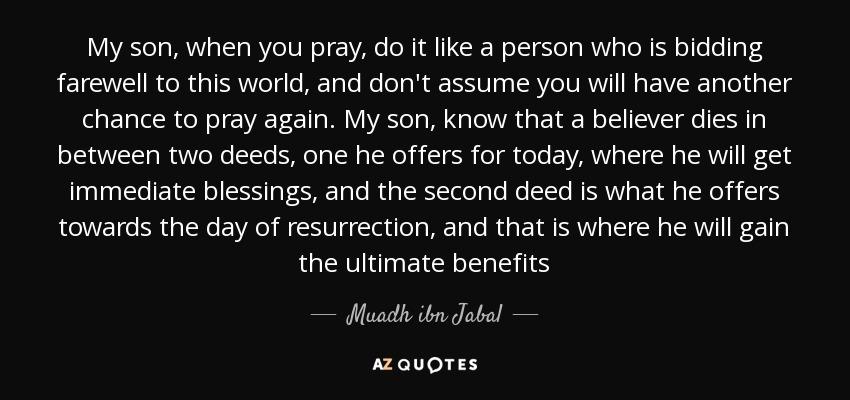
One day, the prophet ran into Mu’aadh and asked him “how are you this morning Mu’aadh?” He answered, this morning I woke up as a true believer,’’ The prophet PBUH said ‘’every truth has its manifestations of your true belief? Mu’aadh readily answered; I have never woken up without believing that I might die before nightfall. I have never slept without believing that I might die before the morning and I have never taken a step without believing that I may die before taking the next. It always seems to me that I can see each nation humbled to its knees and each nation called to its record of deeds. It always seems to me that I can see the dwellers of paradise, wherein the everlasting delights and the dwellers of hell, wherein they are in disgracing torment’’. The Prophet commented, now you know, so stick to the truth as long as you live.’’
Mu’aadh advocated for knowledge and the remembrance of Allah. Moreover he invited mankind to seek the useful and true knowledge saying, “I warn you against the deviation of wise men. You will know the truth when you see it, for it has a distinctive light.” He believed that worship was an end and a means to reach justice. One day, a man asked him, Teach me,’’ Mu’aadh asked him, Will you obey me if I teach you? The man answered I will not disobey you in anything. He said then ‘’Fast, then break your fast. Pray during the night but you must get some sleep. Earn what is halaal and what is rightfully yours and do not earn sin. Die as a true Muslim. Finally, I warn you against the supplication of the oppressed ‘’. He believed that education meant knowledge and practice, therefore he said, learn whatever you like to learn, yet Allah will not make your learning worthwhile unless you practice what you have learnt.
At the end, death summoned Mu’aadh. It was the time to meet Allah. When the stupor of death creeps upon someone, his subconscious takes the reins and spurs the tongue to disclose the reality of all mankind in concise words that summarize his life story. In those blessed moments, Mu’aadh faintly uttered great words that revealed a great believer, for he gazed up into the sky and humbly supplicated ALLAH, the most high, saying “Allah, I used to fear you but now I implore you. Allah you know that I did not devote my life to travel in the lands or to earn money or property but rather consecrated it to knowledge, faith and obedience, notwithstanding intense heat or hardship.”
Mu’aadh gave up the ghost at the age of 33years while a report said 37years, despite his death at this age, he is the imam of the scholars in the paradise, and the most learned of the halaal and haram. May Allah be pleased with him and all the companions.
My brethren, for you is to learn your deen for indeed with it, the halaal and haraam are known.
alfaaedahpress
Al-Faaedah is the flagship journal of MSSN Akinyele Area Council, promoting authentic Islamic scholarship, moral leadership, student mentorship, and societal development.
Did you find this reflection beneficial?
Your feedback guides our editorial board on future essays and dispatches.
Reader Discussion (3)
A deeply insightful exploration. The balance between academic discipline and spiritual consciousness is precisely what our student body needs today.
Barakallahu feek Brother Ahmad. May Allah grant our youth steadfastness in learning and practice.
Jazakumullahu Khayran to the editorial team. The references from Surah Taha were especially grounding.
Related Perspectives & Notes

HARD BUT REWARDABLE
Allah says "Do people think that they will be let go merely by saying: “We believe,” and that they will not be tested?"

HOW WELL DO YOU KNOW OUR MOTHER; THE QUEEN OF SHEBA?
She submitted to Allah,the Lord of the worlds.Bilkis found peace and solace in her heart when she submitted to Allah. It is such a simple thing to do,yet for ma...
Zaid Ibn Thaabit: The Compiler of the Holy Qur’an
By Kolade Sodiq “By Allah, if they asked me to move a whole mountain from its place, it would have been easier than the task of compiling the Qur’an which they...