
INTERVIEW: “I prepared for my UTME examination for 3 months, and I read for about 5 to 6 hours daily.” — Hammed Maryam Titilayo


In this interview, Hammed Maryam Titilayo, one of the trailblazers of the MSSN Akinyele Area Council’s Extramural Tutorial Center, shared with us her strategies, preparation tips, and how she achieved an outstanding result in the 2025 UTME. Whether you’re a current or an aspiring UTME candidate, this interview contains inspiration, practical advice, and real-life insights to guide you on your journey to academic excellence.
Kindly introduce yourself
My humble name is Hammed Maryam Titilayo, and I hail from Osun State.
What was your UTME score?
I scored 302 in my Post-UTME examination.
Have you gained admission?
Na’am, Alhamdulillah, I have gained admission.
State your institution and course of study.
I am a Law student at the prestigious University of Ibadan.
At what academic level were you before joining the MSSN Akinyele Extramural Class?
Before joining the MSSN Akinyele Extramural Class, I already considered myself academically sound. Throughout my secondary school years, I consistently came out as the best student in my class, so I had a fair amount of confidence in my academic ability. However, that confidence made me a bit too relaxed. I was so sure of myself that my reading culture gradually dropped to a very low level. I did not put in as much effort into studying as I should have because I felt I already understood things well enough.
How did the Extramural classes influence your academic performance and exam readiness?
The Extramural classes influenced my academic performance and exam readiness in a very significant way. One thing that stood out to me immediately was the quality of the tutors. They are incredibly brilliant and very dedicated. They explain concepts with so much clarity and patience that even difficult topics become easier to understand.
What makes their effort even more remarkable is that they are not being paid for the work they do. They teach purely for the sake of Allah, sacrificing their time just to ensure that we understand what we are being taught. Many of them also have their own academic work, personal responsibilities, and family matters to attend to, yet they still dedicate themselves to teaching us. Their greatest joy is simply seeing their students understand.
Another thing I really appreciate about the Extramural class is the way the programme is organised. There is a very unique structure to it. They know when to give us breaks and how to manage the learning process so we do not feel overwhelmed. They also organise weekly tests for us, and these tests contain real exam-standard questions. This helped us become familiar with the kind of questions we would face in examinations and prepared us mentally for them.
All these things put together—the dedication of the tutors, the organised structure of the classes, and the consistent testing—pushed me to take my studies more seriously. It humbled me and made me realise that I had to work harder, so I began to study much more seriously to improve myself.
Can you describe the difference between your academic level before and after the Extramural program?
Before joining the Extramural program, I was confident academically, but my reading and study habits were not consistent. I did well in school, but I often relied on my natural ability rather than putting in structured effort.
After joining, everything changed. The tutorial pushed me to my full potential and made me take my studies seriously, and I started seeing noticeable improvements in my understanding and exam readiness. I even fell in love with studying. It became my hobby—something I genuinely enjoy, not just something I do for the purpose of passing.
One person who really inspired me in the program is my mentor, Rasheed (Shanawiy). He teaches us Government, but the way he teaches makes you realise he is brilliant in so many areas. In every class, you always learn something new. There is no session where you come out empty-handed. Beyond Government, he is good at all subjects, knows how to explain things clearly, and breaks down concepts in a way that makes everything easy to grasp. He makes you want to emulate his discipline and passion for learning. Having him as a mentor has really shaped the way I study and approach academics now.
Beyond academics, how did the Extramural impact your spiritual life and personal discipline?
It positively impacted me spiritually in the sense that I improved greatly in my religion because there are always spiritual diet (lecture) sessions in our timetable. So, I learnt some rules of the Shariah and Islamic perspectives on issues I was ignorant of. I also learnt many dos and don’ts in my religion.
Participating in these SPD sessions consistently strengthened my connection with Allah and shaped my character a lot.
It also shaped my personal discipline through the amazing tutors we are blessed with. They are so well-behaved and disciplined. One of the biggest influences was the behaviour of the tutors and directors. They are some of the most God-fearing, mannerly, and exemplary people I have ever met. Watching how they do everything calmly, respectfully, and moderately taught me a lot about self-control and personal conduct.
I can proudly say that they are the best set of people I have ever come across, and they have impacted me greatly.
How long did you prepare for the UTME, and what was your daily or weekly study routine like?
I prepared for my UTME examination for 3 months, and I read for about 5 to 6 hours daily. I utilised every moment I had and made the best use of it. I sometimes read till 12 midnight and wake up by 2 a.m. to read and also pray intensely.
What study techniques or strategies contributed most to your high score?
The strategies that helped me most were consistent practice of past questions and mock examinations, which helped me manage time and become familiar with the exam format. I also made personal notes and used active recall to test myself. Group discussions with classmates also helped me understand different perspectives on particular topics. Staying consistent with all these techniques really boosted my performance.
What major challenges did you face during preparation, and how did you overcome them?
At first, staying consistent with my studies was a struggle. Sometimes you just feel like not reading, and some topics can be very difficult.
What helped me overcome this was following my mentor’s guidance, taking weekly tests seriously, revising daily, and practising past questions. In the end, staying consistent and making a lot of du’a helped me conquer those challenges.
In your opinion, what would you say was the key factor behind your high performance?
The key factor behind my performance is hard work, discipline, consistency, and a lot of du’a.
What advice would you give to students preparing for the upcoming UTME?
My advice to UTME students is simple: stay consistent and do not underestimate the little efforts you put into studying. Make studying a habit, not something you only do when exams are near. Practice past questions, understand your weak areas, and ask for help when necessary.
Also, do not just study to pass—study to understand. Fall in love with learning, and everything else will follow. Stay disciplined, stay focused, and trust the process. Believe in yourself that you can do it.
Do not copy what others are doing, and above all, pray a lot. Pray as if you do not read and read as if you do not pray. In shā Allah, 320+ is achievable.
Editor’s Note: This interview has been lightly edited for grammar and clarity while preserving the interviewee’s original meaning.
alfaaedahpress
Al-Faaedah is the flagship journal of MSSN Akinyele Area Council, promoting authentic Islamic scholarship, moral leadership, student mentorship, and societal development.
Did you find this reflection beneficial?
Your feedback guides our editorial board on future essays and dispatches.
Reader Discussion (3)
A deeply insightful exploration. The balance between academic discipline and spiritual consciousness is precisely what our student body needs today.
Barakallahu feek Brother Ahmad. May Allah grant our youth steadfastness in learning and practice.
Jazakumullahu Khayran to the editorial team. The references from Surah Taha were especially grounding.
Related Perspectives & Notes
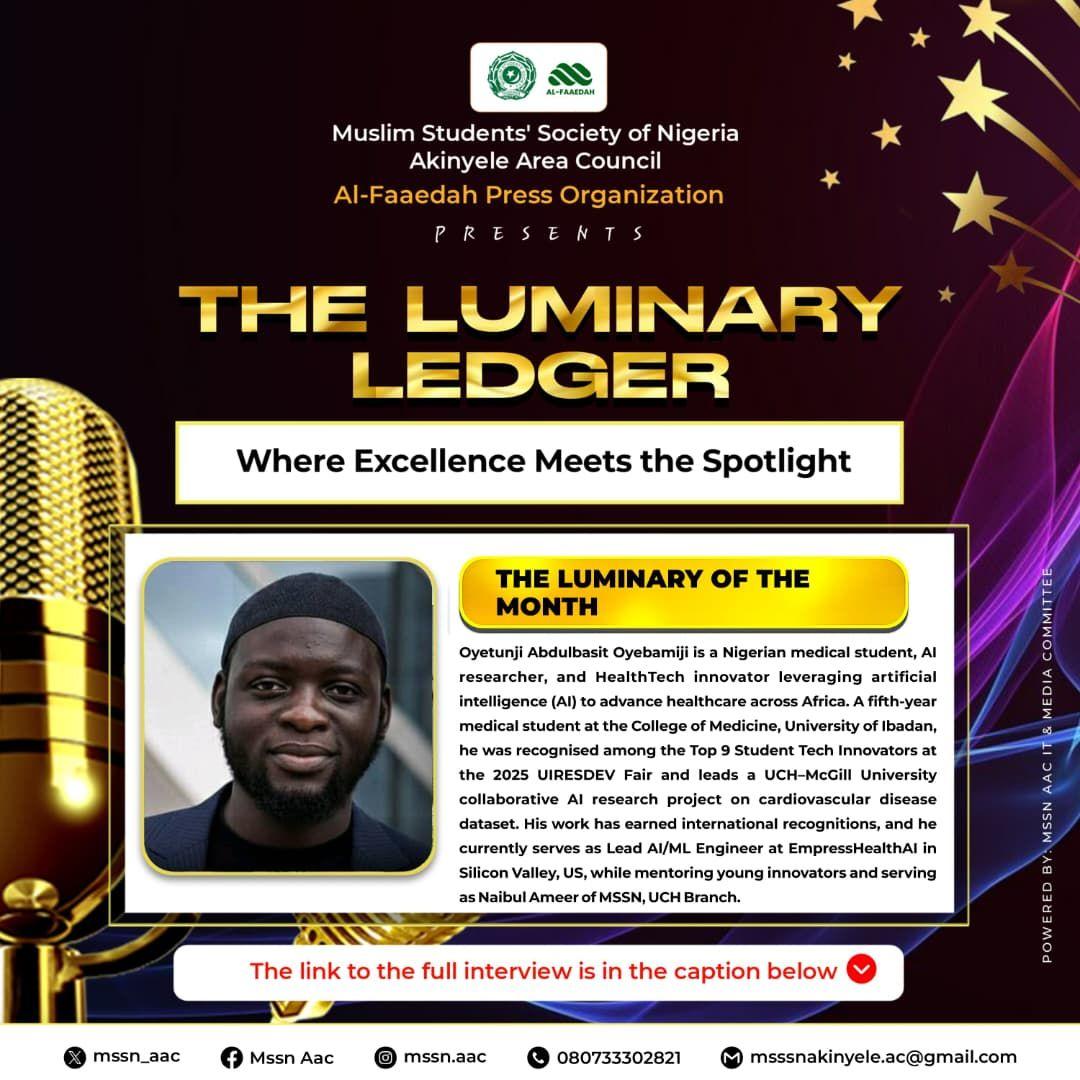
"Medical School Is a Very Jealous Speciality": Abdulbasit on Thriving with Marrying Ibadan Medicine and Artificial Intelligence
In this insightful interview, Oyetunji Abdulbasit Oyebamiji—a fifth-year medical student at the University of Ibadan, AI researcher, HealthTech innovator, and L...

INTERVIEW: “Before Extramural, I could hardly score 20 out of 60 in Physics…” — Maryam Oketunde
In this interview, Maryam Oketunde, one of the trailblazers of the MSSN Akinyele Area Council's Extramural Tutorial Center, shared with us her strategies, prepa...