
"Medical School Is a Very Jealous Speciality": Abdulbasit on Thriving with Marrying Ibadan Medicine and Artificial Intelligence
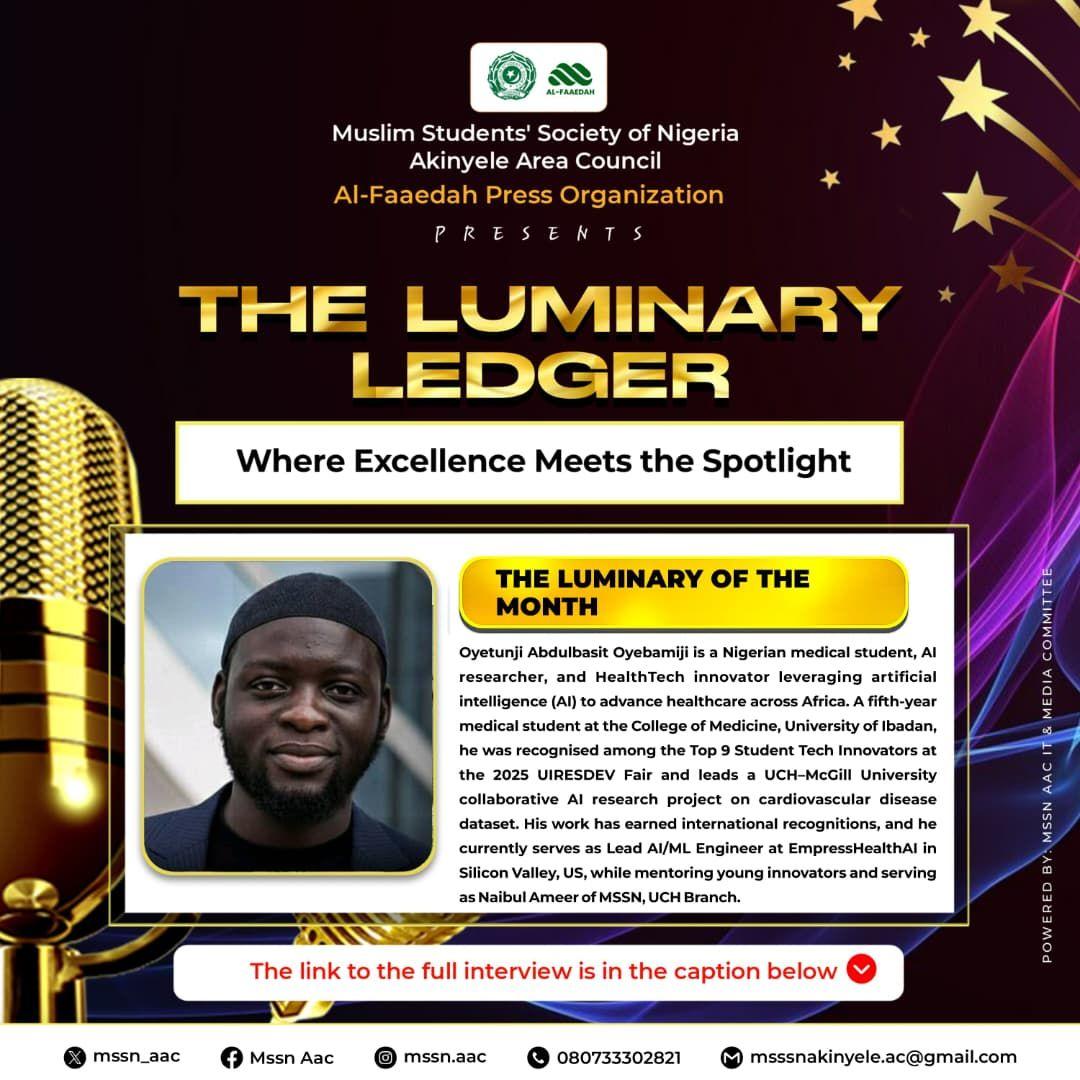
In this insightful interview, Oyetunji Abdulbasit Oyebamiji—a fifth-year medical student at the University of Ibadan, AI researcher, HealthTech innovator, and Lead AI/ML Engineer at EmpressHealthAI—takes us through his remarkable journey at the intersection of medicine and artificial intelligence. From being recognised among the Top 9 Student Tech Innovators at the University of Ibadan to leading cutting-edge cardiovascular AI research in collaboration with the University College Hospital (UCH), Ibadan, and McGill University, Canada, Abdulbasit has established himself as one of the emerging voices shaping the future of AI-driven healthcare in Africa.
Al-Faaedah Press Organization would love you to introduce yourself to our readers
I am Oyetunji Abdulbasit Oyebamiji, a fifth-year medical student at the College of Medicine, University of Ibadan, an AI researcher, and HealthTech innovator leveraging artificial intelligence (AI) to advance healthcare across Africa. I’m also currently the Naibul Ameer of MSSNUCH.
Every remarkable journey has a beginning. Looking back, what experiences or influences first sparked your interest in medicine, research, and technology?
Well, medicine… Well, I can’t really say that there is a particular experience like that for medicine. Yes, because medicine is… I’ve always wanted to study medicine. It’s medicine or nothing. Because, probably the way I know… well, I can say that from a young age—let me put it like that—my parents had always put that particular thing in me: that I should study medicine.
So, I grew up with that. It’s just subconscious that I’m studying medicine. It’s not like I have tried any other thing before and failed over and over and over again, but I knew that it’s medicine or medicine only, and then that’s all we are settling for. So, yeah. I really can’t say that this one thing sparked medicine out of me.
I can say that a particular experience was in 2011/2012, when one of my siblings had an eye issue, I think. So he came to UCH, and there was this younger sister of mine, Mariam, who had septic arthritis at the age of 8 months. She was admitted to UCH here. I can say those moments when we came to UCH further substantiated and strengthened my interest in studying medicine then. That was then, because I was marvelled by the whole treatment of people and everything.
So, I can say that. However, on the grand scheme of things, it’s more of a subconscious thing that has always been brewing in my head—that you are studying medicine, I have to study medicine—rather than probably an antecedent or something that sparked my interest.
So, about research: yes. I can say that initially, after entering medical school, I tried a couple of things. All these researches that involve epidemiology are very difficult things for me to do. Yes, I found it very difficult, very uninteresting, very tough. So, it was just like stressing myself out. I didn’t enjoy it. Honestly, I didn’t enjoy it—until I ventured into tech.
So, I think that should come first. The tech side: well, I can say that it’s really not like there’s something really spectacular about my interest in tech. But I can say it’s just me trying to—should I say—not just be a medical person only, but also try to be someone who can bring in both tech and medicine together. Because one thing I noticed in the context of Nigeria is that we are so far behind. Not because we can’t do it, but because we are trying to standardise what our own technological advancement should be with the US and all these developed countries—which is wrong. You should look for things that work in our own context. Build things using our context or the reality of our locality in mind. Do you get it? Then, build things around that.
So, that’s just it. That’s one of the reasons why I started finding research interesting, and that’s where that research idea came from. Really, that’s where that research interest came from. I tried a couple of things with a couple of friends. I have a friend who is very, very good at this thing. And I can say that I started the tech of a thing when I was close to my MB1, when I crossed to UCH.
And the reason is simple: before then, crossing to UCH was a very tasking thing, and I was just venturing into the university system and medical school. Weighing… like, putting additional weight of tech on it when I have not really understood how the system works or gotten accustomed to it can be very, very devastating. So, I had to pass my first MB, then try and move into it. But it has always been something that is at the back of my mind to do.
So then, after moving, why is it AI? I find it difficult to just be building something like all these software engineers—front-end, back-end—do. It doesn’t have life in it, yes. As someone who studies medicine, to me, medicine is more of bringing back to life a kind of—I don’t want to say dead, but dying entity.
Artificial intelligence in the tech world mirrors medicine so much. And as someone who has an interest in medicine, who is studying medicine, artificial intelligence is the exact—to me—replica of medicine that I’m studying, but in the tech world. Because it amuses me to build something that literally has a thinking of its own and has a life of its own, literally.
Yes, I built something, and I can communicate and even ask it some things. I can tell it, “These are the contexts to which you should answer,” and it will do exactly that. Literally, I can build an entity that can perform on its own, that can literally execute tasks. To me, that’s more satisfying, especially for a medical person, than anything. So, that’s why I can’t thrive in building software or full-stack. It will not give me that joy that I want—that satisfaction.
I was telling a friend of mine when we were preparing for my O&G EOPT a couple of weeks ago that I can sit down at the back of my PC working on stuffs for 8 to 10 hours straight without dozing, without even really feeling tired. But once I open my book, in 10 minutes I will yawn. Yeah! Yes, it’s funny, but that’s the truth.
Yes, I will yawn, because, unless I’m reading a topic that is really, really fascinating like that. But most times, I will just start dozing off and all. But I’ve never dozed off when I’m working on a project, because the end product is always what’s in my mind. And the end product is not just a static product that you toggle on and off; it’s a product that has its own life. You can literally evaluate it by asking it this, and it answers back to you, by telling it, “What is your opinion on this?” and it gives you an answer about it. So, that’s a whole life on its own. And it’s what amuses me about artificial intelligence.
Now, to the research. You build all these things. Research allows you to have an understanding of the basis. All technological advancement stems from research. There is no technological advancement except that it stems from a lab in a university, trust me. Not from a factory, not from a company. It’s all from a lab, and it’s all from a university or a scientific—or let me say, an academic—kind of thing.
So, that’s where the research comes in. As someone who is fascinated with artificial intelligence, at the same time, I’m fascinated with: How do they really come into being? With that, I then thought: Which area is best for me when it comes to research? Of course, you can’t do all the research areas together. So, that’s where I realised that the best way I can do research that is going to really apply to a maximum extent is the “medical imaging” world.
And that’s why I ventured into it. I got an opportunity, like a scholarship, to study at an AI academy – SPARK Academy. I graduated last year. It’s more like a 10- or 11-month program, so I finished at the end of last year. I’m currently in that academy as a team coordinator now, coordinating Oyo State. There are a lot of teams, including other countries, within the academy.
Majorly, what we do is train people. Then after training, we take them through research. So, I was trained there, and now I’m coordinating other people’s training currently. We’ve even finished our research and submitted it already.
So, yeah! That’s literally my journey through medicine, or let me say, the influences that sparked my medicine, tech, and research.
Was there a defining moment that made you realise artificial intelligence could become a meaningful part of your medical career?
Thank you very much. The defining moment—I really don’t know. Before, artificial intelligence wasn’t something that was all around, and it’s not something that everyone knew. Artificial intelligence came into being around 2022 upward; that’s when it came into the mainstream world, via chatgpt.
So, the defining moment where I realised artificial intelligence would serve as a very good tangential point in my medical career was during the MSSNUI weekly faculty meeting at UI Central Mosque. We invited Dr Abdul-Qudus Ajibade—this was in 2023 or early 2024, I can’t really remember precisely. We invited him to come and speak. He is an AI engineer, and he currently works with a company in the US. At that time, he was a medical student. We invited him to come and speak on artificial intelligence, and it was that particular lecture he gave on artificial intelligence in healthcare that really showed me the possibility and informed me more about artificial intelligence.
I decided to move more with him so that I could understand it and see if it was something I could venture into. That was actually the defining moment. Today, I don’t want to graduate as a medical doctor alone; I also want to graduate as an AI engineer with a medical degree. In the world today, there is a new concept called Clinical AI, and it’s not going to be manned by engineers—it is going to be manned by doctors who are AI-oriented and who can build a clinically responsible artificial intelligence. There are a lot of ethics governing artificial intelligence in medicine that an ordinary engineer will not understand fully, so it’s only a doctor who is also an expert in the field of artificial intelligence who can do justice to that.
Medical school is demanding on its own. How have you managed to balance clinical training with research, innovation, leadership, and professional commitments without compromising excellence?
There is no balance. There has never been balance with medical school. Medical school is a very jealous speciality. Most times it requires you to give it everything. Because you are not only learning theory, and you are not learning things to just pass that course and move on to the next level, unlike other standard ones. You are done with, let me say, Anatomy 101; that’s the end—you really don’t have much reason to go back. But that’s not it in medicine. You continue carrying and carrying. Most of the courses you are going to do in the 400 level, the exam is in the final year. So that’s how medicine is. There is no balance.
I’m into artificial intelligence as a medical student. I’m into research, and these are not just research questionnaires—I’m into a lot of research. I have my AI research, and at the same time, I also have researches I’m leading in some other things that require questionnaires, literally. But then, the AI research is something that is more of sitting down with code—sitting down with code, running experiments on GPUs, and all. So it’s something that takes time, commitment, and brainpower. I can say that it takes brainpower.
So there is no balance, and there are compromises. There are compromises, and I learned that too. If you are going into something like this, don’t expect to be an exemplary student—exemplary in the sense that you are a student who is getting 90s and 100s. You can do research and still spank… but I mean, in my own context, I know what I’m combining. I’m not someone that says that I have to get the distinction by fire, by force. Because to me, I’m trading that “perfect” academic excellence—perfect in quotes—with things that I believe in my own context are more worthy to me than that.
I believe that there should be more to me than just a medical doctor with distinctions. I believe that the world needs doctors who not only understand their medicine as it should be, but are also experts in the engineering aspect of artificial intelligence. Because in a couple of years to come, artificial intelligence will be the norm in the things we do. If we don’t have people who are good in that way as doctors, then it will be very, very difficult for us to build systems that work in our settings.
So now, how do I try to balance it? Yes, that should be the question, because I never balance it. The way I try to balance it is that Yoruba used to say, “Mọ̀jà mọ̀sá làá makinkanju lójú ogun” When I realise that these are times I have to put in complete effort, then I ditch every other thing to face that one alone and pass it. Let me give an example.
When I was preparing for my MB 2, when we were in Block 2 and Block 3 Pathology and Pharmacology posting, I attended Madrasa before that, but once we started Block 2 and Block 3, and MB 2 was on its way, I stopped Madrasa. I stopped Madrasa completely because I know that Block 2 is one of the most strenuous postings in this med school, and MB 2 is one of the craziest MBs you will ever write in medical school. So combining it with Madrasa, with work—because that time I was working with a startup in the US, a Silicon Valley-based startup—that was when I started working with the startup. That one, I can’t even ditch it. So I had to leave Madrasa at that time because Madrasa is something that I can always go back to, and I have to pass my MB 2, also.
At the same time, I was still in SPARK Academy as a student. That was when we were working on our final research paper and everything, so I had a lot going on. I had to prioritise things that I had to keep and things that I had to ditch for that particular time. So the strategy is simple: at an instance of time, there are things that I rank as the top, and there are things that I drop. Medical school is a stay—it’s a stay. Every other thing, I can rank it above medical school at a particular point in time, and at a particular point, they will be the lowest on my table that I’ll have to ditch them at that time.
These are just the ways I cope. There are times that I don’t touch codes at all for a couple of weeks or months because at that time, I have to focus on some other things that matter. But if I have an imminent exam, or an MB, I will ditch every other thing outside medicine to a large extent and face it and pass that one. Then immediately I finish, I will leave medicine for a very long time, face the things that I’ve left, try and cover them up, and then proceed.
This is just the way I try to balance most of these things. I can say that with that, I’m still able to maintain the academic excellence that I want in my own context. I’m still able to achieve them, and at the same time, I’m still able to achieve things that I want to achieve. I’m still able to do my work, I’m still able to do my research, I’m still able to go to Madrasa. Immediately after we finished our MB, in the following semester I resumed Madrasa. Yeah, there are instances where I have to repeat a class all over again, but I’ve never repeated because I failed, it’s always because I ditched modrasa and couldn’t write the promotional exams. Most of the people that we entered together are graduating this year, and I’m three years behind. It’s just so funny, yes. People that we entered Madrasa together are graduating this year. They are in “Soffu Shahaadh (the final year of an Arabic secondary school), and I’m still three years behind.
It’s me who knows the race I’m running. I know my reality. I know my priorities at certain instances of time, and I know what I want at a particular time, things I have to achieve, and the time I want to achieve them. It’s literally my own game to play. I’m not playing for any other person. I know when to stop Madrasa, I know when to restart, I know when to stop my research, I know when to continue, I know when to stop work; I know when to continue. The only thing that stays is medical school—I never drop it at any time. Though I may tone it down—probably after exams, or I’m in a very chill and easy posting, I’m gone; I’ll use that opportunity to catch up with some of the extra-medical school things I’m doing. But in reality, I just try to leave one and do the other, and come back. That’s just the way I’m able to balance everything.
In all sincerity, there is never a balance, and there has always been a compromise. There is no perfection in any one of these things. I used to be a very top A student before, like when I was in UI—90s and 80s. But now I’m more of a 70s and 60s student, though I still have 100s and 90s, but not as common. That’s the compromise I’m trying to talk about, do you get? If I still want to maintain those 90s and 80s, then I should forget about the extra-medical school things that I’m doing, do you get? But if I know that I still want to do all those things, because those are the things that really give me joy and make me impactful in the things I want to do, then I will have to settle with that compromise of getting my 60s and 70s in med school, and not the 90s that I used to get.
Throughout your journey, what has been the most challenging obstacle you’ve encountered, and what lessons did it teach you?
Now, okay. So, the most challenging obstacle that I’ve encountered… well, I can say learning. Yes, having to learn the skills and knowledge of tech, in a sense, is like learning coding. It’s very challenging.
Yeah, and I will say that it’s something that I encountered that is really very difficult. At one point, I almost quit. Yes, and the reason is simple: there is medicine going on that is very, very jealous. So, I still had to do that also, and learn.
So, that’s where I will say… what lesson did it teach me? The lesson it taught me is persistence, one. And two, having mentors. Yes, having mentors. Having someone that has walked the path that you are also passing through—that’s medicine—and he’s also doing what you want to do, and that’s AI.
So, I can say that Dr Ajibade Abdulqudus, who is a mentor to me, is someone that, through him, I had to learn that, sometimes, you don’t have to pass through the conventional way everyone passes through. Have the right mentor who is going to tell you, “Oh, these are actually the things that you need. You don’t need this at this particular point in time. Over time, the fact that you learn this will allow you to understand these other ones.” And that’s just it.
So, the obstacle I have is having to learn. While how I was able to solve it and the lesson I was able to derive from it is having a mentor in everything you do. If you don’t have a mentor, it will make things that should be beginner-level difficulty be expert-level difficulty for you. You will just be overwhelmed by the whole thing, and you won’t even be able to progress. But with a mentor, you’ll be able to have a pathway to follow: do this at a particular time. These are the pathways to follow to achieve this specific thing. So, it’s all about having a good mentor, honestly. So, have a good mentor. Everything that you want to learn, once you have a good mentor, you are fine.
It is through him that I was able to get into the AI school that I learned most of my things from. It is through him that I got the research opportunity and things that I was able to do. So, most of these things are through him. And yes, also I have my own personal grit. But without him, it would have been 100 times more difficult. So, which is one thing that I can say is one of the most challenging things to do.
And the lesson it teaches me is simple: consistency. Never think that something is undoable, and have a good mentor. Whatever you want to achieve, look for someone who is passing through what you are currently passing through or has passed through it, and who has achieved or is achieving what you want to achieve. The person will understand your own context better.
For example, he is a medical doctor. Then, he was a medical student. So, I was also a medical student. So, you understand that, okay, this is the area—it’s not the mainstream artificial intelligence that I want to do; it’s more of the one that applies in the healthtech space. So, he was able to put, “Okay, this is what you need. Enrol here, do this and that.”
And after crossing over to UCH, I had to go and live in his room. Yes, I lived in his room for over four months. Once I crossed over, I was staying with him. So, I was learning inside his room. Most of the work he does, I also sit down and look at and try to learn. So, if I have any questions, I ask at that instant. So, it sped up my learning process—the fact that I had to live with him. Do you get? So, it makes things a lot easier than I thought, than it may seem to be as difficult.
So, yes. Having mentors to put you through and who are ready to guide you is the best way to overcome that obstacle. Yes!
And also, I have friends. I have a friend that I can say knows a lot when it comes to tech, and that’s Ibikunle Jamiu (Emjay). Ibikunle Jamiu knows almost everything. I’m serious at this point; I’m not trying to exaggerate. He knows almost everything: front-end, back-end, artificial intelligence. He knows all languages—Python, Java, C++, Rust, PHP, every language; he knows them.
So most of the time, especially now… he’s not a classic AI engineer; he’s just a senior developer, and he works at Eagles Lab. So, he’s my classmate. So, most times, if I have a problem, I will run to him, and he will solve it for me.
Having people that you can run to to put you through—especially me—is one of the ways I am still surviving. So, if I have any problem that I’ve spent days racking my brain… one of the research projects that I’m just rounding up now, I was having a problem with SSH. I’m trying to learn it, so I was having a problem with it to be able to run my experiments on the cloud, or a server-based GPU, a compute. I didn’t know how to go about it. I had to go and meet him, and he put me through: “This is how you do this, this is how you do that,” and he taught me everything. I was able to use it, and I’m still using it till today.
So, having that calibre of people around you—people that you are ready to allow to mentor you, people that you are ready to say, “Come and teach me”—is one of the ways that one is going to survive and be able to overcome most of these obstacles. Yes!
Much of your work focuses on applying AI to healthcare in Africa. What gaps in our healthcare system do you believe artificial intelligence is best positioned to address?
Okay, so gaps in our healthcare system… I believe AI is best positioned to address speed. That’s the gap: speed.
Currently, as of today, based on the current statistics, the total number of registered doctors with MDCN is around, I think, 120,000 to 150,000; I’m not sure. And the active ones that are still presently working with us in Nigeria are about 55,000 to 60,000 doctors. And the population of Nigeria as of the 2006 census was around 200 million—I’m sure we are more than that, but let’s say 200 million. So, we have about 55,000 to 60,000 doctors serving 200 million. The ratio is a minimum of about 1 to 4,000 doctor-patient ratio. And it is even worse in the North, in which their doctor-patient ratio is 1 to 10,000.
That makes speed a very crucial thing that I feel artificial intelligence can help Nigeria with in a Nigerian context. That means a doctor needs to find a way to see more patients to keep up with the workload without the doctor being too used up in the process.
For example, a doctor on a normal day probably can see about 20 patients. If the doctor is to speed up their ability to see 50 patients, the doctor will most likely collapse because he will use himself up. But with artificial intelligence, the doctor will still be able to see up to 50 without affecting their health or hurting the doctor’s health.
So I believe that speed is key, because we don’t have enough doctors to see this workload of patients. It’s something I see every day in UCH here.
I believe that with artificial intelligence that helps with triaging, sorting out some things, diagnosis—faster diagnosis of patients—and evaluation of patients, it makes things a lot easier to do and faster. You can cover up a lot of patients within a limited timeframe. I can say that one of the spaces where that is very helpful the most is in the medical imaging space.
There are a lot of patients that need to undergo radiological imaging, probably an X-ray, MRI, and so on. At the same time, the consultant will have to sit down with each of the images and try to evaluate and give verdicts or comments on those images, and it is those comments that will now follow.
If we can have artificial intelligence that is as good as a consultant level—and I can say that MedNeXt and others that are so good are still not at par with most of these consultants who have been in the system for over 30 years—if we can have such artificial intelligence, it will not replace a doctor. Artificial intelligence will never replace a doctor.
Let me give a small analogy to that. A data scientist or statistician who decides that he’s not going to learn Excel, but he’s good with numbers and has all the formulas in his head… let’s say that statistician has a First Class, he’s the BGS of their school, and he knows everything once he carries his pen. Then we have a 2:2 guy who also graduated, and he’s not as good as that guy, but he’s very, very good with Excel. They both apply to a big data company that works with billions of data points. Whom do you think they are going to hire? Of course they are going to hire the guy who can do Excel, because he will be able to work with large numbers at the same time perfectly without error. The work of just a day, the guy with the First Class who doesn’t know Excel will do in a month, and he will still be prone to error.
That’s exactly what artificial intelligence is: it will not replace doctors; it will only make them more efficient and faster. It will allow them to be able to work with lots of data, see more patients, and improve healthcare outcomes with it.
I believe the aspect of speed—in the Nigerian context of having to see lots of patients with a limited doctor workforce and a small doctor-to-patient ratio—is a problem that I believe artificial intelligence will help us conquer if we can master it. With that, we’ll be able to see more patients without the doctor having to stress out, pass out, or die because they are seeing more patients. It’s saddening, but I believe that with artificial intelligence, those things are going to be solved.
Your CardioRisk Predictor App earned recognition at the University of Ibadan Research and Development Fair. What inspired the project, and what impact do you hope it will have on healthcare delivery?
Thank you very much. What inspired the Cardiorisk Predictor app was an assignment at Spark Academy that I graduated from. We were all given that assignment to train models on a specific cardiovascular dataset, evaluate the models, and submit the results.
So I did that. But it was very funny to me, and I found it not appealing enough. How am I going to train a model on this? The model achieves very good results, and eventually, I just submit the results, and there is no way we can even use those models? It doesn’t make sense.
So then I embarked on the journey of, okay, if I can train this model and get this result, then this particular model has to be useful in the real world. So I reached out to my mentor, Dr Ajibade Abdulqudus, and asked, “How do you think I can do this? I’ve trained this model; this is what I got.” At that time, I was able to train the model, and I was able to get about 60% accuracy and precision.
He laughed at me. He was like, “Your model was literally just guessing.” Yes, I should go and find a way to improve it. Then he exposed me to a concept called feature engineering. So I went online, I learned, and applied it, and I was able to bring the model from about 60%, which is literally guessing, to 80% accuracy.
So then, after showing him, he was very happy, and I was like, “How can I make this a real-world solution?” Then he put me through: “You can do this, you can do that, deploy here, Streamlit and all.” He put me through everything, and I implemented everything.
I didn’t only finish the project; I showed it to my mentor at SPARK Academy. She saw the project; she saw what I was able to make out of that mere assignment that was given at the academy, and she was wowed. So she invited me to a conference in Lagos to come and present the finished work.
During the presentation, I was asked, “Which dataset are you using in training your model?” I was like, “Oh, it’s this dataset.” The person who asked was like, “This is a Caucasian dataset. In Medicine, geographical location, race, age, these things are very important and can affect the results in lots of ways, especially in the artificial intelligence space.” So the best thing, in order to make this really relevant in the African context, is to train the model with African datasets.
What the Cardiorisk Predictor can do is that it can predict both the percentage and whether you are at high or low risk based on the clinical parameters that you provided: your age, your gender, your blood pressure, your cholesterol level, your sugar level, and all these parameters. At the same time, it will tell you the percentage of how close you are to the high-risk level. If you are 10% closer or 20% closer, it will tell you.
What inspired the project was the assignment that was given at SPARK Academy, and that’s exactly what inspired the project. The impact I believe it’s going to make—that’s just a beginning project; it’s really not a finished project. One of the diseases that can be predicted, that should be predicted, is cardiovascular disease. They don’t start all of a sudden like trauma, no. It is something that has been brewing up over time, then at a particular point, the system can no longer take it, and everything collapses.
If you can see far into the future, about 10 years away, that this person is at high risk of developing this particular cardiovascular disease, then with that, you can be able to say with full confidence that you can prevent it. You don’t prevent things that you don’t know are going to happen. So if you can look at a person’s family history, their diet, their blood pressure over time, and everything, you can be able to predict their likelihood. I’m trying to build an AI-powered app that will be accessible, that will be able to, just by all these little details, tell you how close you are, and then with that, you can start adjusting your lifestyle in order to not fall into these things in the future.
And alhamdulillah, this project earned me the UIRESDEV Award of one of the Top 9 UI Student Tech Innovators of the Year 2025.
So that’s the impact I want it to make, especially in an African context.
You are leading a collaborative project with UCH and McGill University to develop an African-centred cardiovascular dataset. Why is developing local datasets so important for AI research, particularly in Africa?
Thank you very much.
The McGill University and UCH collaborative project is an extension of the cardiovascular risk predictor. At that conference, I was asked, “You trained this model with a Caucasian dataset, but this is an African population.” Judging by my knowledge of medicine, I know that when it comes to things like this—geography, race, and all these parameters—they are very, very deterministic. They can affect patient outcomes; they can affect diagnosis.
So with that, I took it upon myself. After the questioner asked me that question, I said I’d try and work on it. I tried to look everywhere to get African datasets. I thought it would just be easy: just get an African dataset, train this thing, and oops, we have an African cardio risk predictor app.
But the funniest thing: no, there is none! It’s just so funny. There is none. The only one that is available in a research paper is the one for Ethiopia. And they only make the paper available; the dataset itself, they did not make publicly available. So, there is no publicly available dataset for cardiovascular disease that you can use to train an AI model. I searched, I did not see. I will appreciate if someone has one.
But that’s what birthed the dataset project. Because of that, an associate professor reached out to me. She’s an associate professor in the Institute of Neurological Sciences in Montreal, McGill University in Canada, and the head of SPARK. She reached out to me and was like, her PhD students were also working on similar projects like the cardio risk predictor. She was the one who invited me to the conference at Lagos. After the conference, she called me and was like, “Can I work with some of her PhD students in this field if we can bring some things together and work on some of the projects?” I was like, “Ah, no problem, why not?”
Then over time, it turned out to be a project that had to be done as a standalone, not with most of her PhD students as we intended. Because of that, under her guidance and supervision, I wrote out a research proposal that I submitted to the Head of Cardiology Unit here, Professor Oga of the Cardiology Unit in UCH. He was very, very interested in it. After reading it, he said the best thing for me to do is to reach out to Professor Owolabi in the Neurology Unit, who is a neurologist. Professor Owolabi heads a particular network called SIREN (S-I-R-E-N), which is a research hub on stroke.
I was able to reach out to him, and we are still collaborating on the project alongside the associate professor in McGill University, Dr. Maruf Adewole who is a postdoctoral fellow at the University of Pennsylvania, and a consultant radiologist, Dr. Ada. We are all on a team trying to work on this project alongside Professor Oga and Professor Owolabi to get this done.
We believe that if we can have this African dataset public, not only will it allow us to build and complete that particular cardio risk predictor app in an African context, it will also allow other ideas that solve African-specific problems to come up and have enough data to solve those problems. The problem we Africans have is that most of this data, the people that have them don’t make it public due to one reason or the other best known to them. Because of that, innovations are driving slowly in the African context, and we are the ones who need to speed up innovations and solutions to solve our problems.
This project is to build an African dataset from our own data itself to solve our own specific problems, and eventually make it public for other people to use to solve their problems. So, we are still working on the project.
As Lead AI/ML Engineer at EmpressHealthAI, you’re contributing to healthcare solutions beyond Nigeria. How has working in an international HealthTech environment shaped your perspective on innovation?
What I can say about that is that it shows how limitless the sphere of innovation in the medical or health tech world is.
At EmpressHealth AI, we are working on perimenopausal women’s health. In the Nigerian context, this field is not a niche, only for me to discover that it is a multi-billion-dollar niche in the health tech space, and it is very much untapped, honestly.
This is very funny to me, because things like that really don’t matter here.
Another thing is the way we reason here is far different from the way they reason there. The way they approach problems from the perspective of possibility rather than being speculative. Once they see a problem, they look for a way to solve it, no matter what, as much as they can do.
Once you see a problem, just find a solution to it. And no matter how small the solution is, let people know. Because no matter how much the problem seems insignificant to you, there’s someone out there for whom it’s actually a major problem. And you solving it will not be such a big thing to you until you put it out there.
They don’t just see problems as problems; they see them as an opportunity. They put in everything they can to solve problems with every resource they have. They don’t limit the resources they need to solve a problem, no matter how small it is.
Beyond your technical work, you’ve taken on several leadership and mentorship roles. What philosophy guides your approach to leading teams and developing others?
I can say leadership, and I can say mentor to some people, but I am also still a mentee. I am still learning. I’m far more of a mentee than anything.
But yes, I mentor people. And honestly, I can say that I’m not doing as much as I wish I were. Probably because I still feel like I am a mentee on my own, and I don’t think I have all it takes to be a mentor to people.
But to the best of my capability, I still try to put people through within the confines of the little knowledge that I have.
And in terms of leadership roles, I have taken lots of leadership roles in various spheres, and also in the tech space. I am a Research Lead at Mafi Learning Collectives (ML Collectives), where I lead a team of AI researchers on a research project on medical imaging and segmentation using deep learning approaches. We have been working on a couple of research projects; we have finished a couple, and we have submitted two for review and to conferences.
One of the philosophies that I see about it is that, as a leader, you need to be more willing than every other person there if you want to be successful in whatever thing you’re leading. For example, you’re leading a team, and you have a goal; you need to be more interested in achieving that goal than every other person. Or else, you won’t succeed.
When people that you’re leading see how much you put into the success of that particular project, they won’t have a choice but to continue being there; when they see that, as the leader, you’re always there, always taking the bull by the horns.
That’s something I have noticed about the health tech project. As much as you have the understanding and the technical skills, for you to actually be a good leader, you need to take the role.
Because one of the major problems we have in all these leadership roles is that most of the people we lead, a lot of people don’t have the skills to bring the project into fruition. So because of that, over time, they just get silent. You don’t hear from them; no one says anything again. It happens a lot.
But once you, as a leader, are active, even when no one is saying anything, you try to work on it. You put people through. You let people learn along the process rather than just pushing them to achieve the goal.
People will work with you. They’ll be able to stand up, even when they don’t have enough skills to get the thing done. They’ll feel free to approach you and ask, “How should we do this? What do you think that we can do on this?” And with that, the project will be done.
As a leader, you have to have the goal that the project is successful. Number one, it has to be successful. And then, you yourself should take the bull by the horns. So that’s for most of the leadership roles I have taken.
But as for the mentorship, I really can’t say that I am so good at it. Because I’m still a mentee. I’m still learning, and it is very difficult for me to… I don’t see myself as having enough skill to say, “Now let me be a mentor,” which I think is bad.
But with the little I have, I am trying as much as possible to inculcate it into people whom I see that they’re also ready to learn, and also ready to impact, and also ready to improve me too on my own side.
Through SPARK Team Oyo and the UCH Tech Society, you’ve mentored aspiring AI practitioners. What common misconceptions do young people have about artificial intelligence, and how do you help them overcome them?
After trying to mentor people at Spark as the coordinator and mentor them on achieving some of the goals set by the academy, one misconception that I’ve seen is that a lot of people think that artificial intelligence is more of a once-you-get-there, especially in the field of medical imaging deep learning, that you just come, and then you go. They don’t know that it is something that actually takes a lot of effort and will.
Let me use myself as an example. When I graduated from Spark, we were around 15, 16 from the start, and I think about two, three or four people eventually graduated from the school.
I can say for the team, for the cohort I’m coordinating currently, about 16, 18 started from the beginning, and I can only say that the research that we just finished and we just submitted, the paper we just wrote, only about five people or four people eventually finished. Others couldn’t cope.
And that’s the misconception. People think that it’s a sprint. It’s not a sprint; it’s a marathon. They should be ready to make mistakes, and that’s how you learn. It’s not difficult. It’s more of applying yourself over and over. You make mistakes, you learn, you do another thing, you make mistakes, but as you are making mistakes, you are actually improving, and that’s just it.
So another misconception that I notice, that a lot of people think, based on the little relationship I’ve had with some of them, is that they think it is too overbearing, and they eventually leave it.
To learn artificial intelligence, all you need to perfect is Python. A lot of people think that you need to know Rust, C++, and JavaScript. No, you really don’t need all those things. If you are very proficient in Python, you’ll scale through, trust me. And Python is one of those languages that is the easiest because it has a lot of libraries that take care of a lot of things for you, so it’s very easy to learn.
Now, one thing that a lot of people don’t know is where to start, where to begin. They just think that they will take it from the top. But I believe that if you have good mentors that you can follow, they’ll guide you. For example, I was able to have a mentor: Ajisco. He would tell me, “Start from this. When you’re done with this, move to this.”
Anytime I finish a particular work, I’ll still go and meet him and tell him, “I’ve finished this thing o, what’s the next? What should I do next?” He would say, “Move to this.” So, it was easier. I was able to build that knowledge and use it along the way.
But a lot of people don’t really know. They tend to take so much, get so overwhelmed, and leave it. They don’t actually know that what you need is just Python. Once you learn that Python very well, then from there, you’ll be building on them, and before you know it, you are fine.
So, that’s just it. People think that it is too complex. So, they take so many unnecessary things. Yes, it is complex, especially when you are going into the research field. It’s very complex. But you need a good mentor who will guide you through it step-by-step, from the least thing that you need to learn over and over again, so that you won’t eventually waste your time, you won’t learn irrelevance, and you’ll be able to learn things that actually matter in what you want to apply it to.
Artificial intelligence is vast. We have deep learning, machine learning, LLMs, MLOps. There are a lot of fields. There is VLLM, these video parts. There are a lot of fields under it.
And some of them may have similar structures, but their technicalities are very different. So if you want to learn one, you actually learn it as a standard. The knowledge is transferable, obviously, but then you have to learn that one. Then if you want to learn another, you will learn it.
But if you know about one a lot, it will allow you to quickly learn others. But there are a lot of fields there, and it is actually the one you want to learn first that will determine what you have to equip yourself with. And that’s where a lot of people get it wrong in the first place.
Thinking that it is too complex and overwhelming yourself with a lot of irrelevance is one of the misconceptions. Another one is not actually knowing the right basics to learn, in order, and being able to apply whatever you are learning to the field. That is another misconception.
You’ve received numerous grants, awards, and international recognitions. Which accomplishment holds the deepest personal significance for you, and why?
Well, about the accomplishments that I really found significant—there are two.
The first was presenting my project at the Medical Artificial Intelligence Lab (MAILAB) Research Conference in Lagos. It meant a lot because the project started as a simple assignment, and I was able to develop it into a product worthy of presentation at a research conference.
The second was receiving the MICCAI Grant Award. What made it special wasn’t the grant itself, but the recommendation behind it. I was recommended by an Associate Professor at McGill University whom I had been working with. Seeing the recommendation letter on the official letterhead of the Montreal Neurological Institute, McGill University, and reading her words about my work was a proud and humbling moment.
That experience taught me the importance of adding value wherever you work. When people genuinely appreciate your contributions, recommending you becomes natural because they have seen your impact firsthand.
More than the grant itself, the entire process gave me confidence and momentum. It also showed me that one success can create opportunities for the next, as long as you keep growing and doing meaningful work.
You actively combine demanding academic and professional responsibilities with leadership in the Muslim Students’ Society of Nigeria and Islamic studies. How has your faith influenced your pursuit of excellence and your understanding of success?
Islam does not condone mediocrity. As a medical doctor and as a Muslim, you shouldn’t just be a medical doctor; you should be a Muslim medical doctor.
I organised a symposium a couple of weeks ago: the Medico-Islamic Symposium by MSSN UCH. Since I am the Naibul-Ameer, I am the one in charge of da’wah and stuff like that. I organised that symposium, and a doctor was brought to speak on the topic: “Female Genital Mutilation and Female Circumcision: Islamic, Medical, and Ethical Perspective.” We did not just bring a lecturer to speak on that topic. We brought someone, “Dr Ridwan Salam.” He’s not just a consultant family physician; he’s the Chief Imam, Jericho Specialist Hospital. With that, he was able to do justice to the topic from both the medical and Islamic perspectives.
And that’s the kind of doctor I want to be. Not just a doctor who knows the medical stuff and knows nothing about its relationship with Islam and what Islam says. Because most of this medical knowledge was actually pioneered in the spheres of Islam, by Muslims. All these medical intricacies and modern medicine are being pioneered by Muslims.
So, I want to be a doctor who doesn’t just understand the medical stuff, but also has the Islamic basis of most of these things, so that I will be able to practice my profession better than just an average medical doctor, an average Muslim who doesn’t even know.
To me, I think that Islam, firstly, apart from the fact that it doesn’t encourage mediocrity… that is part of the reason why, apart from being a medical student, I go to Madrasah to learn. It’s not easy.
And one of the major things I say is that it’s not balanced. Anytime I see that I have an upcoming exam that is very serious, I leave Madrasah because I can always go back to Madrasah. I pass the exam first, then I go back to Madrasah.
Second, I also see that I can’t be completely fulfilled as a doctor if I’m not an AI engineer. After eight to nine years in this medical school, and I only just graduate with an MB;BS ?, I won’t feel fulfilled. That’s a waste of a whole decade.
I can’t just graduate with an MB;BS. I have to graduate with other capabilities. I think AI engineering is one of them, and the knowledge of my Deen should also have improved drastically. Not just the MB;BS.
So those are the things I feel like influence most of my thoughts. I want to not just be a doctor; I wish to be an engineer, an AI engineer to be specific, in which I will be able to apply it in the clinical field and pioneer a lot of spheres in Nigeria.
That’s one. And two, I also want to be someone who understands his Deen, especially the Deen in the medical space, so that I will be able to understand the stand of Islam on so many medical ambiguities that often happen.
Looking at the rapid advancement of AI, what opportunities—and responsibilities—do you believe today’s healthcare students should prepare themselves for?
I used to say that AI is the new Excel. Anytime I’m speaking, as an upcoming healthcare student, you need to learn how to use AI efficiently. Efficiently.
And as I do give the analogy, a statistics student who is very, very good, with first class, but does not know how to use Excel, and a second-class lower who knows how to use Excel very well, but doesn’t even know much of those calculations. Of course, they are going to choose the person who is, because that one will be able to handle big data.
And that’s… AI will not replace healthcare medics. AI will not replace you. AI will only replace those who cannot use it to work. Because AI allows you to work on a lot of things within a limited time. And that’s actually what computers do. It’s just that AI has its own intelligence. It can actually do things on its own.
So if you’re not very good at it, you will lose a lot. Because in the world to come, that’s actually the tool. It will now become a tool that you use to do things. So if you’re not very good at it, if you’ve not integrated yourself into it over the years, you’ll just become irrelevant in the field.
And people that are very good at it will be able to use the tool to work on large amounts of data. And that’s actually what firms, that’s actually what companies, especially all these big companies, want. People who can do things, work on big data, big volumes of things, like larger volumes of things in less time, and still be able to achieve great success.
That’s what AI is going to do in certain times. So if you don’t get… there are a lot of opportunities that this thing gives. There are a lot of opportunities that AI, artificial intelligence, gives that we are not tapping into. Yes!
And I think that everyone should also try as much as possible to look into the sphere of, “How can I make use of AI to improve the field I am in?” Because different fields have different ways artificial intelligence influences them.
So I believe that a lot of people have a couple of things, whatever career path, that also make use of AI, that work with AI, and that sit with them and see opportunities that lie within their career path, and also hold on to it as early as possible.
Because in the next five, ten years, if you’re not very good at these things, if you’ve not adopted them, you will just see that everyone has moved on and you’re still where you are.
If resources and limitations were no obstacle, what healthcare problem in Africa would you dedicate yourself to solving first?
If resources and limitations were no obstacles, what healthcare problem would I solve?
Well, I think the healthcare problem that I am going through, especially in the context of Africa, is having a centralised EMR, honestly.
And I believe that if that can be solved across the whole of Nigeria — let’s use Nigeria as a case study — if all public or government hospitals digitalised their medical records, there will be a surge in technological advancements in the whole healthcare sector. Trust me, a lot of advancements, especially in the artificial intelligence space, should have sprung up sporadically in Nigeria. But because we don’t have a system that digitalises things, and because we need the data, the way things are is extremely difficult.
That’s why some of the projects I’m working on are on datasets. Because I’m sure once you have that dataset, building solutions that will actually be meaningful in the context of our reality—the reality of our healthcare space—will be very easy. We will be able to build up. The way things work outside Nigeria doesn’t match the reality here.
Some countries have never had a case of malaria for the past 10 years. They don’t even know how to manage it. If malaria happens, it’s an emergency. It’s a crisis. It’s something that everybody will be running up and down. They will quarantine that person and everybody in contact for simple malaria. But here, you have malaria, and people will laugh at you for not being serious because of malaria; you didn’t even come to work.
Today, I just got one of the patients. Someone just spoke to me this afternoon that his daughter, who lives in Saudi Arabia, just came to Nigeria and within a few weeks succumbed to severe malaria that eventually caused convulsions. The lady is in a coma now, literally unconscious, from severe malaria.
To tell you that the context of healthcare is defined by geography, by location sometimes. So the reality here can only be solved by our own local data. Ensuring that we are digitalising medicine, digitalising all the government hospitals, especially government hospitals, because those are the hospitals that have the workload that can generate those things.
If we can digitalise everything, trust me, in 10 years a lot of technological advancements will spring up and make access to healthcare easy, and make it easier for people than what we have currently.
Many AI beginners start excited but get overwhelmed, lost in endless tutorials or discouraged by the field’s complexity. Having walked that path, what advice would you give them to start well, stay focused, and grow with confidence?
The advice I would give is to find a mentor. Whatever area that you want to go into, look for a mentor who is in that area.
Artificial intelligence is not just something that you go online to tutorials and go and learn. It’s focused learning that you do. Because there are a lot of fields under artificial intelligence. So whatever area you want to learn, you need to find someone who will put you through: “Learn this one first. You don’t need this one.”
I remember AJISCO telling me, “You don’t need this. You don’t need this. You don’t need this. Learn this. Learn this. If you can learn this, learn this one too.”
With that, you won’t make a lot of mistakes. You won’t waste your time and energy on things that don’t matter, things you don’t need. And eventually, those are the things that matter, the things that actually work in whatever field you want to use them.
And that’s why eventually a lot of people get overwhelmed and just leave, because they actually don’t know what they should learn, the extent to which they need to learn it, and how to actually apply it in real-world situations.
Because one of the things that helps you whenever you are learning is the ability to actually see your work, like, coming to life. That’s why a lot of frontend developers are getting… because what they are developing, they can see it.
But if you are writing code and you can’t even see the results, you get overwhelmed. And AI is very good in that when you can finish the project, whatever you are learning, do a project, and you can see it come to life, you will be motivated to do more.
But if you don’t have someone to put you through focused learning on what to actually learn step by step to achieve that minimal success, then you will be overwhelmed.
So the solution I can say is to get a mentor in that field you want to learn in that is willing to put you through, and you, too, are willing to learn. Once you get that, honestly, you will be able to scrape through the stress, and you will successfully learn and be able to apply it in whatever field you wish to apply it.
Just get that mentor. I think that’s the first thing. A mentor that is willing to put you through.
Many students admire achievements like yours but often feel overwhelmed by where to begin. What practical advice would you give someone who hopes to build a meaningful career at the intersection of medicine, research, and artificial intelligence?
I’ll say, find a niche that you wish to work on. Find a niche that you think has an intersection between medicine and anything.
Then, after finding that niche, look for people who work in that field who can serve as your mentor. Mentorship is the major thing. You can’t do it alone.
Once you get that, every other thing gets easy.
But look for that niche that you want that has that intersection. Then look for someone who works on that, or something similar, that can put you through.
So, that’s the practical advice I can give. Look for a mentor who is working on, or has worked on, something similar, if not exactly that thing, in that same field, that same intersection.
Look for the person, and try to get the person to mentor you on how to go about it.
What is one principle or habit you believe has contributed most to your journey?
I don’t have any principles. I can only say, Allah.
I don’t think I have achieved anything so far. But Alhamdulillah, I am not where I started from. I can say that two years ago, I hadn’t even done anything. So only Allah made all these things possible.
But personally, I can’t say that this is my principle; anything I feel like, I just do it. I don’t allow myself to doubt myself. I don’t care what people actually think. Once I see that this is something I want to do, I look for a way to actually get it done, with little excuse.
I might not get it then, but over time, I plan and orchestrate everything in my head. And once I start, I start getting everything done.
So I don’t say that there’s a special principle I have, but apart from Allah, the only thing I can say is guidance. And getting a mentor. Get someone to put you through. That’s the only way to do something fast and get things done.
No matter what you want to do, someone has passed through that stage and gotten it done. You won’t be the first person. The person will put you through and teach you how to avoid their own mistakes. Then things that are supposed to take a year will take three to four months.
Anytime you want to do things, don’t wait for permission. Just do it. Reach out to people. Ask questions. Just do it.
Is there a book, person, or experience that has profoundly shaped the way you think and lead?
Well, there is no book or experience.
But I can say that I have a mentor. That’s Dr Ajibade Abdulqudus.
I’m not really someone who likes books, honestly. People that are very close to me know that I’m not a reader like that.
What is one misconception about success that you wish more young people would abandon?
Well, success is a journey, and success isn’t something that, once you get there, you have arrived.
Success attracts more success, so if you’re succeeding in something, it makes the next success easy. You’ll then continue to be more successful as long as you don’t stop.
The first, second, and third successes are the hardest, but to continue is easier. The first momentum is what is difficult.
But once you’re able to scale through one, it’s easier to be able to succeed in other ones that are tougher than that. It gets easier over time.
So that’s one thing I want people to understand about success. The first couple of successes will be very difficult. But trust me, if you don’t stop, the next rounds will be very easy.
Looking ahead, what legacy do you hope your work will leave for Africa and the next generation?
The legacy I wish to leave is that I hope to build a system. By Africans and for Africa. Things that are built by us, especially in the AI world. Things that are built by us, for us, and work for us.
Most of the things we use today are things that white people do. But they actually don’t work here because our reality is different.
So one of the things I wish to do is to build a context-aware system. So that’s why most of the work I do is always context-aware. They’re always African, because I believe that that’s what really matters.
I can’t be providing solutions to a problem of a white man when my own people here, when my own people here, are still having the same problem. That’s not sensible.
So any problem I am trying to work on is a problem that works for us, that will work for us. So it is a solution that will solve our own problems.
So the legacy is that people who are coming should also inculcate the habit of solving our local problems first, because that’s what matters.
Finally, if your life journey were to be remembered in just one sentence, what would you hope that sentence would be?
I don’t think I’ve reached a point in my life to be able to define it in a sentence (laughs).
I’ve not even started the journey (laughs).
But all in all, ٱلْحَمْدُ لِلّٰهِ عَلَىٰ كُلِّ نِعَمِهِ عَلَيَّ
alfaaedahpress
Al-Faaedah is the flagship journal of MSSN Akinyele Area Council, promoting authentic Islamic scholarship, moral leadership, student mentorship, and societal development.
Did you find this reflection beneficial?
Your feedback guides our editorial board on future essays and dispatches.
Reader Discussion (3)
A deeply insightful exploration. The balance between academic discipline and spiritual consciousness is precisely what our student body needs today.
Barakallahu feek Brother Ahmad. May Allah grant our youth steadfastness in learning and practice.
Jazakumullahu Khayran to the editorial team. The references from Surah Taha were especially grounding.
Related Perspectives & Notes

INTERVIEW: “Before Extramural, I could hardly score 20 out of 60 in Physics…” — Maryam Oketunde
In this interview, Maryam Oketunde, one of the trailblazers of the MSSN Akinyele Area Council's Extramural Tutorial Center, shared with us her strategies, prepa...

INTERVIEW: “I prepared for my UTME examination for 3 months, and I read for about 5 to 6 hours daily.” — Hammed Maryam Titilayo
In this interview, Hammed Maryam Titilayo, one of the trailblazers of the MSSN Akinyele Area Council's Extramural Tutorial Center, shared with us her strategies...